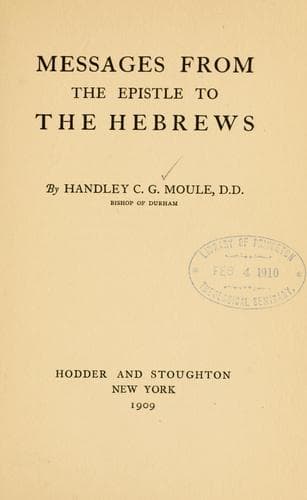
Messages from the Epistle to the HebrewsMoule, H. C. G. (Handley Carr Glyn)
Religion
Messages from the Epistle to the Hebrews
Moule, H. C. G. (Handley Carr Glyn)
Bible. Hebrews -- Commentaries
"Now faith is the assurance of things hoped for, the proving of things
not seen." So the Revisers translate the first verse. They place in
their margin, as an alternative, a rendering which makes faith to be
"the giving substance to things hoped for, the test of things not seen."
I presume to think that the margin is preferable as a representation of
the first clause in the Greek, and the text as a representation of the
second. So I would render (with the one further variation, in view of
the Greek, that I dispense with the definite article): "Now faith is a
giving of substance to things hoped for, a demonstration of things not
seen." And we may paraphrase this rendering somewhat thus: "Faith is
that by which the hoped-for becomes to us as if visible and tangible,
and by which the unseen is taken and treated as proven in its
verity."[L]
[L] A friend has pointed out to me that in the recently discovered
papyri, which, although a relatively small part of them only has been
read as yet, have thrown much deeply interesting light on the character
and vocabulary of Greek as used by the New Testament writers, the word
[Greek: hypostasis] is found with the meaning of "title-deeds." On the
hypothesis of such a meaning here (we can only speak with reserve), we
may paraphrase: "Faith enables us to treat things hoped for as a
property of which we hold the deeds."
In the light of what we have recalled regarding the position of the
first readers of the words, we have only to render them thus to see
their perfect appropriateness, their adjustment to an "exceeding need."
The Gospel led its disciple supremely and ultimately always towards the
hoped-for and the unseen. True, it had a reference of untold value and
power to the seen and present. There was then, as there is in our day,
nothing like the Gospel to transfigure character, on the spot, here and
now, and thus to transfigure the scene and the persons around the man,
before his eyes, within reach of his hands, in the whole intercourse of
his life, by giving them all a new and wonderful yet most practical
importance through the Lord's relation to them and to him. But it does
this always and inevitably in the power and in the light of facts which
are out of sight now, and of prospects essentially bound up with "the
life of the world to come." The most diligent and sensible worker in
Christian philanthropy, _if he is fully Christian_ in his idea and
action, does what he does so well for the relief of the oppressed, or
for the civilization of the degraded, because at the heart of his useful
life he spiritually knows "Him that is invisible," and is animated by
the thought that he works for beings capable, after this life's
discipline, of "enjoying Him fully for ever." He labours for man, man on
earth, because he loves God in heaven, and because he believes that God
made man and redeemed man for an immortality to which time is only the
short while all-important avenue. In the calmest and most normal
Public-domain text, read in full here on John Shaqi.
Reviews
Reviews
No reviews yet
Be the first to share your thoughts on this work.
Join the Discussion
Join the discussion
Sign in to leave a comment or review.
Sign InorCreate an account