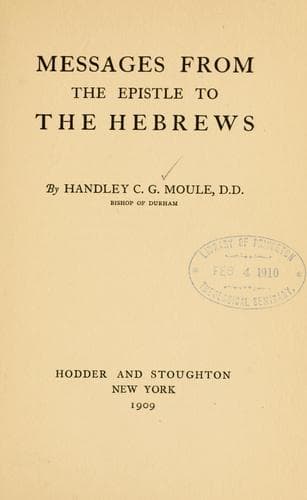
Messages from the Epistle to the Hebrews — John Shaqi
Messages from the Epistle to the HebrewsMoule, H. C. G. (Handley Carr Glyn)
Religion
Messages from the Epistle to the Hebrews
Moule, H. C. G. (Handley Carr Glyn)
Bible. Hebrews -- Commentaries
Beautiful is _the sympathy_ of this appeal to live, by faith, the life
of victorious patience. "All chastening, for the present, seems not to
belong to joy but grief" (ver. 11). Yes, the immediate pain is here
fully recognized, not ignored. It is not spoken of as if, in view of its
sequel, it did not matter. "It belongs to grief." Scripture is full of
this tender insight into the bitterness of even our salutary sorrows,
and its appeals to patience are all the more potent for that insight.
"Nevertheless, afterward, it produces the peace-bringing fruit of
righteousness," the sense of a profound inward rest, found in conformity
to the "sweet, beloved will of God," in living correspondence to the
Father's rule, "for those who have been exercised, as in a spiritual
_gymnasium_ ([Greek: gegymnasmenois]), thereby." That "exercise" was to
tell at once, as they surrendered their wills to it in faith, in a
present sense of the certainty of future blessing. "Brace the slack
hands" to toil, "and the unstrung knees" to march (ver. 12), "and make
straight paths for your feet," using your will, faith-strengthened, to
choose the line of the will of God, and that alone. So should "the lame
thing" be "healed" rather than "turned aside." The walk, feeble and
halting always when the will is divided, should be restored to firmness
and certainty again.
"Nevertheless, afterward." That is the watchword of the whole pregnant
passage. Nature, shortsighted and impatient, can deal with the seen and
the present only. Grace, in its victorious form of patient faith,
already takes hold upon the "afterward," and works on, and walks on, "as
seeing Him that is invisible."
With the thought of the witness-cloud around us, and "looking off" to
the Prince of Faith, ascended, yet present with us, and sure of the
ultimate and eternal "fruit of righteousness" which lies hidden in the
chastening of the Father of our spirits--we too will live by faith,
taking God at His word, and saying Amen to His will, even to the end.
CHAPTER XI
SINAI AND SION
HEB. xii. 14-28
Public-domain text, read in full here on John Shaqi.
Reviews
Reviews
No reviews yet
Be the first to share your thoughts on this work.
Join the Discussion
Join the discussion
Sign in to leave a comment or review.
Sign InorCreate an account