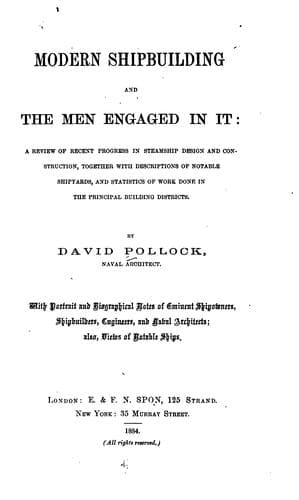
Modern shipbuilding and the men engaged in it — John Shaqi
Modern shipbuilding and the men engaged in itPollock, David
History
Modern shipbuilding and the men engaged in it
Pollock, David
Shipbuilding -- Great Britain
The activity characterising merchant ship construction, and
especially the enormous increase in their dimensions and speed within
recent years, have necessarily led to speculation with regard to what
form the ship of the future will take. There have not been wanting,
indeed, actual propositions and elaborately prepared designs of
what the ideal ship should be. A company was sometime ago formed in
Washington, U.S., to have three vessels built of a novel type, the
patented invention of Captain Lundborg, a Swedish engineer, intended
to make the Atlantic passage in five days. It was also announced that
the order for their construction had actually been given out, but
this is wanting in confirmation. Great expectations were entertained
in America regarding what was termed the dome-ship _Meteor_, built
on the Hudson in the early part of 1883 from the designs of Captain
Bleven. A company had been formed under the designation of the
“American Quick Transit Company,” the chief supporters being Boston
merchants, to build several large steamships on the proposed lines,
but the utter failure of the _Meteor_ to answer the promises of her
inventor has relegated the scheme to the vast limbo of unfulfilled
American projects. Three years ago or more, scientific journals gave
publicity to a scheme of “Ocean Palace” steamship, patented by Mr
Robert Wilcox, of Melbourne, Victoria, the claims for which ranked
themselves under the heads of speed, safety, and comfort. Double
hulls, as in the case of some Channel steamers, were employed, but
each of the hulls was divided into two cigar-shaped portions, thus
giving to the submerged whole, a quadruplicate character, and which,
with its palatial superstructure, was apt to remind one—shall it be
said?—of Rome and her seven hills, or Venice and her island base!
The design, nevertheless, was to give the least resistance with the
greatest buoyancy and stability. The method of propulsion proposed
by Mr Wilcox was also novel. He placed a couple of enormous drums
fore and aft (between the hulls), which were to be driven by the
engines as if they were paddle-wheels. Over these drums was placed
a continuous band of iron links, upon which, at suitable intervals,
paddles or blades were fixed. A comparatively low speed of engine was
to give a high speed of velocity to this band of blades; and as there
would be twenty-one paddles, all immersed at the same time, their
grip of the water was to be such that there should be little slip.
Whether on a serious application of the principles involved in this
invention to a ship for the Australian service the voyage would have
been made, as was claimed, in 26 days, equal to an increase in speed
of 75 per cent., has never of course been determined! Still another
scheme, and one which the inventor has been encouraged to prosecute
by the recommendations of eminent authorities on both sides of the
Atlantic, is that of Captain Coppin, noted for his success in salvage
Public-domain text, read in full here on John Shaqi.
Reviews
Reviews
No reviews yet
Be the first to share your thoughts on this work.
Join the Discussion
Join the discussion
Sign in to leave a comment or review.
Sign InorCreate an account