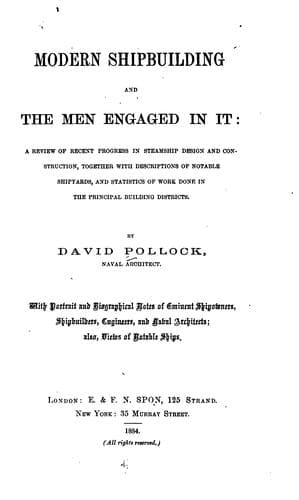
Modern shipbuilding and the men engaged in itPollock, David
History
Modern shipbuilding and the men engaged in it
Pollock, David
Shipbuilding -- Great Britain
operations, which consists of an “Ocean Ferry” partaking as to form
somewhat of the features above described for Mr Wilcox’s “Ocean
Palace.” The speed said to be possible by Captain Coppin’s vessel is
twenty knots an hour, and the terminal ports proposed are Milford
Haven and New York. It was announced some time ago that M. Raoul
Pictet, the eminent engineer of Geneva, was engaged upon the question
of ship design and propulsion, and was in hopes that by application
of his ideas he might yet send ships careering over the sea at the
rate of thirty-seven miles an hour!
Enough has been said to show that there is no lack of inventive
effort being put forth towards a realization of the ideal ships of
the future. In a service, however, like that of the Atlantic, where
competition is strong and keen, and where the monetary issues are
neatly adjusted between rival companies, there is little chance of
any of the various projects being tried. An impression exists among
shipowners—for which doubtless there are sufficient grounds—that
time and capital staked on novelties or “new departures” are simply
invitations to defeat in the race or to absolute ruin itself. This
commercial prudence and industrial caution has been startled in
several ways of recent years—_e.g._, by meteoric flashes such as
the _Livadia_ and _Meteor_—the ultimate effect of which has been to
illumine and make clearer the probable line of advancement.
By pretty general consent of those most competent to judge the
ships of the immediate future will possess the broad distinctions
of being either purely passenger or purely cargo-carrying mediums.
It is equally agreed that twin in place of single screw propellers
will be employed, and that for the express ships nothing less than
20 knots per hour will be considered satisfactory. On a subject,
however, concerned not with historical facts, but with theories and
scientific forecasts, it may be well not to enlarge, especially
as the future is evidently charged with possibilities of which
present-day designers can have but indefinite notions. The subject
of employing electrical energy as the propulsive power on board ship
is at the present time engaging serious attention, but the degree of
practical and commercial success attained does not, as yet, warrant
any anticipation of its immediate application to vessels beyond small
craft, such as launches and ferries. In the midst, however, of such
immense and marvellous works achieved by this great—and, in some
senses, modern—force, it would be both idle and unwise to keep out of
view the possibilities of its future as affecting ship propulsion.
List of Papers and Lectures bearing on the speed and propulsive power
of modern steamships, to which readers desiring fuller acquaintance
with the _technique_ and details of the subject are referred:—
ON THE BOILERS AND ENGINES OF OUR FUTURE FLEET, by Mr J. Scott
Russell: Trans. Inst. N.A., vol. xviii., 1877.
Public-domain text, read in full here on John Shaqi.
Reviews
Reviews
No reviews yet
Be the first to share your thoughts on this work.
Join the Discussion
Join the discussion
Sign in to leave a comment or review.
Sign InorCreate an account