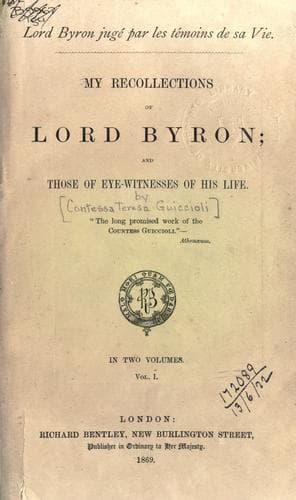
My Recollections of Lord ByronGuiccioli, Teresa, contessa di
General
My Recollections of Lord Byron
Guiccioli, Teresa, contessa di
Byron, George Gordon Byron, Baron, 1788-1824; Poets, English -- 19th century -- Biography
Childe Harold does not tell his own story. His life is told by a poet.
There are, therefore, two well-marked personages on the scene, perfectly
distinct and different from one another. The first is the young nobleman
in whom Byron intended to personify the precocious perversion of mind
and soul of the age, and in general the blased existence of the young
men of the day, of whom he had met many types at Cambridge, and on his
first launch into society. The second is the minstrel who tells his
story.
The heart of the former is closed to all joy and to all the finest
impulses of the soul; whereas that of the other beats with delight at
the prospect of all that is noble, great, good, and just in the world.
Why identify the author rather with the one than with the other--with
the former rather than with the latter? Why take from him his own
sentiments, to give him those of his hero? That hero can not be called
mysterious, since in his preface Byron tells us himself the moral object
for which he has selected him. If Childe Harold personifies Lord Byron,
who will personify the poet? That poet (and he is no other than Lord
Byron) plays a far greater part than the hero. He is much oftener on the
scene. In the greater part of the poem the minstrel alone speaks. In the
ninety-three stanzas of which the first canto is composed, Harold is on
the scene during nineteen stanzas only, while the poet speaks in his own
name during the seventy-four other stanzas, displaying a beautiful soul
under various aspects, and exhibiting no melancholy other than that
inherent to all elevated poetry.
As for the second canto, it opens with a monologue of the minstrel, and
Harold is forgotten until the sixteenth stanza. Then only does the
melancholy hero appear, to disappear and reappear again for a few
moments. But he rather seems to annoy the minstrel, who finishes at the
seventy-third stanza by dismissing him altogether; and from that moment
to the end of the canto the wretched and unamiable personage does not
reappear. To whom, then, belong all the admirable sentiments and all the
virtuous aspirations which we read of toward the end of the canto?--to
whom, if not to the minstrel himself? that is, to Lord Byron. What poet
has paid so noble a tribute to every virtue? Could that vigor and
freshness of mind which breathe upon the lips of the poet, and which
well belonged to him, suit the corrupted nature of Harold? If Byron
dismisses his hero so often, it is because he experiences toward him the
feelings of a logical moralist.
Public-domain text, read in full here on John Shaqi.
Reviews
Reviews
No reviews yet
Be the first to share your thoughts on this work.
Join the Discussion
Join the discussion
Sign in to leave a comment or review.
Sign InorCreate an account