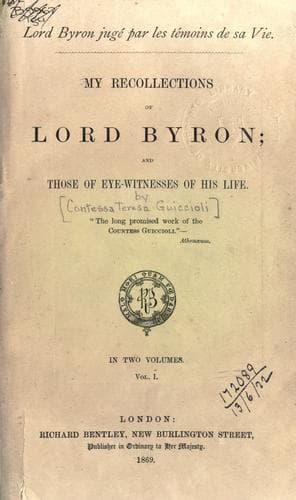
My Recollections of Lord ByronGuiccioli, Teresa, contessa di
General
My Recollections of Lord Byron
Guiccioli, Teresa, contessa di
Byron, George Gordon Byron, Baron, 1788-1824; Poets, English -- 19th century -- Biography
It is, however, indispensable to remark, that in each of these
characters there are two distinct realities. The one tries, by a display
of too much energy, to overstep the limits of the natural; the other
brings the subject back to its true proportions by idealizing it. The
first is the result of the poet's observations of men and their customs,
or of his study of history; the other, by the impossibility which he
knows to exist in him of departing from the rules of art by pushing
reality to the point of making of it a positive suffering. In the first
case his heroes are like one another by their analogy in the use and
abuse of strength; in the other they are like Byron, because he has
almost instilled a portion of his own life into them, in order to
idealize them.
Conrad is the real pirate of the AEgean Sea: independent, haughty,
terrible in battle, full of energy and daring such as becomes the chief
of corsairs, and such as Byron's study of the country where the action
lies pointed out to him that such a man should be placed. But the poet
describes himself when he makes Conrad, at the risk of his own life,
save women from a harem, or shudder at the sight of a drop of blood on
the brow of a lovely maiden. The spot on Gulnare's forehead, while
causing him to suspect some crime, banishes all her charms in his eyes,
and inspires him with the greater horror from the fact that the love
which she had sworn him probably inspired her with the foul act, to save
his life and restore him to liberty. He accuses himself with having been
the involuntary cause of it, and feels that his gratitude will be a
torture; his former love for Gulnare an impossibility. We find Byron's
own nature again in the ascetic rule of life to which Conrad has
subjected himself, and in his passionate and ideal tenderness for
Medora, whose love, in his eyes, surpasses all the happiness of this
world, and whose death plunges him into irretrievable despair.
In the "Siege of Corinth," Alp is the real type of the historical
Venetian renegade, who is incapable of forgiveness, and who makes use of
all his energies to gratify his revenge. But he represents Byron when he
speaks of the impressions which he felt under the starry canopy of
heaven the night before the battle, when his imagination, taking him
back to the happy, innocent days of his childhood, he contrasts them
with the present, which for him is one of remorse, and when there
glimmer still in his soul faint lights of humanity which make him turn
away from the horrible sight of dogs devouring the dead bodies of men.
Public-domain text, read in full here on John Shaqi.
Reviews
Reviews
No reviews yet
Be the first to share your thoughts on this work.
Join the Discussion
Join the discussion
Sign in to leave a comment or review.
Sign InorCreate an account