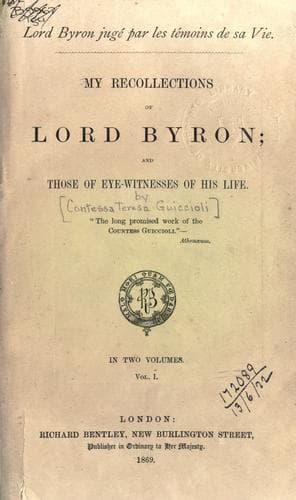
My Recollections of Lord ByronGuiccioli, Teresa, contessa di
General
My Recollections of Lord Byron
Guiccioli, Teresa, contessa di
Byron, George Gordon Byron, Baron, 1788-1824; Poets, English -- 19th century -- Biography
Byron speaks in his own person in the introduction of the "Giaour,"
which is replete with most exquisite beauty. In it he opens to the
reader unexplored fields of delight, leads him through delicious
countries where all is joy for the senses, where all recollections are a
feast for the soul, and where his love of moral beauty is as strongly
marked in his praise of olden Greece, as is his condemnation of modern
degraded Greece. Byron speaks again in his own name when he puts
invectives in the mouth of the Mussulman fisherman, and makes him curse
so strongly the crime of the Giaour and the criminal himself, whose
despair is the expiation of his crimes and the beautiful triumph of
morality.
In the "Bride of Abydos" (where the terrible Ali again comes forward in
the shape of the old Giaffir) the amiable and unfortunate Selim and the
poet share the real sentiments of Byron. Byron is also himself when he
adorns his heroine with every grace and perfection of body and soul, and
also whenever it is necessary to idealize in order that a too rigorous
imitation of reality may not offend either the laws of art or the
feelings of the reader. As for "Don Juan," it is only fair to say that
he in a measure deserved the persecution which it brought upon him. Yet,
if we judge the poem with no preconceived severity, we shall find that,
with the exception of certain passages where he went beyond the limits
prescribed to satire, from his hatred of hypocrisy, and also at times as
a revenge against his persecutors, the poem is charming. These passages
he intended to suppress,[1] but death prevented him. This is greatly to
be regretted, for otherwise "Don Juan" would have been the most charming
satirical poem in existence, and especially had not the last four
cantos, written in Greece, been destroyed. The scene lay in England, and
the views expressed in them explained many things which can never now be
known. In allowing such an act to be committed for the sake of sparing
the feelings of some influential persons and national susceptibilities,
Byron's friends failed in their duty to his memory, for the last four
cantos gave the key to the previous ones, and justified them. From the
moment Byron conceived "Don Juan" he steeled his heart against feeling;
and he kept to his resolution not to give way to his natural goodness of
disposition, wishing the poem to be a satire as well as an act of
revenge. Here and there, however, his great soul pierces through, and
shows itself in such a true light that Byron's portrait could be better
drawn from passages of "Don Juan," than from any other of his poems.[2]
We have sufficiently proved, we think, that the uniform character of
Byron's heroes, which has been blamed by the poet's enemies, was merely
the reflection of the moral beauty which he drew from himself. It might
almost be said that the qualities with which he had been gifted by
Heaven conspired against him.
Public-domain text, read in full here on John Shaqi.
Reviews
Reviews
No reviews yet
Be the first to share your thoughts on this work.
Join the Discussion
Join the discussion
Sign in to leave a comment or review.
Sign InorCreate an account