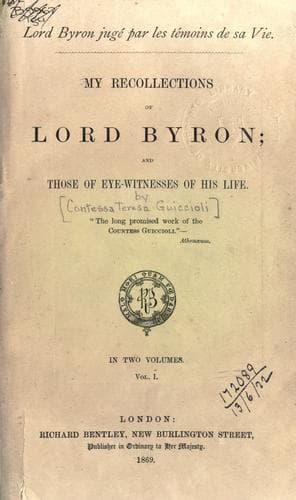
My Recollections of Lord ByronGuiccioli, Teresa, contessa di
General
My Recollections of Lord Byron
Guiccioli, Teresa, contessa di
Byron, George Gordon Byron, Baron, 1788-1824; Poets, English -- 19th century -- Biography
We have been led to dwell upon this phase of his literary career, at the
risk even of tiring the patience of the reader, from the necessity which
we believe exists to destroy the phantom of identification which has
been invoked, and to explain the moral nature of Byron in its true light
before analyzing the poet under other aspects. It is not in "Harold" or
in "Conrad," nor in any of his Oriental poems, that we are likely to
trace the moral character of Byron, for, although it would be easy to
detach the author's sentiments from those of the personages of these
poems, yet they might offer a pretext of blame to those who hate to look
into a subject to discover the truth which does not appear at first
sight. Nor is it in "Manfred"--the only one of his poems wherein,
perhaps, reason may be said to be at fault, owing to the sickness under
which his soul labored at the time when it was written, and to his
diseased imagination, produced by solitude and unmerited grief. In his
lyrical poems Byron's soul must be sought. There he speaks and sings in
his own name, expresses his own sentiments, breathes his own thoughts;
or, again, in his elegies and in his miscellaneous poems, in his dramas,
in his mysteries, nay, even in his satires--the noble and courageous
independence of which has never been surpassed by any satirist, ancient
or modern--and generally in all the poems which he wrote in Italy, and
which might almost be called his second form. In these poems no medium
is any longer required between his soul and that of the reader. It is
not possible any longer to make any mistake about him in these. The
melancholy and the energy displayed in them can not serve any more to
give him the mask of a Conrad, or of a Harold, or of a misanthrope, or
of a haughty individual, but they place in relief what there is of
tender, amiable, affectionate sublime in those chosen beings whom God
occasionally sends upon earth to testify here below of the things
above:--
"Per far di colassu fede fra noi."--PETRARCH.
Public-domain text, read in full here on John Shaqi.
Reviews
Reviews
No reviews yet
Be the first to share your thoughts on this work.
Join the Discussion
Join the discussion
Sign in to leave a comment or review.
Sign InorCreate an account