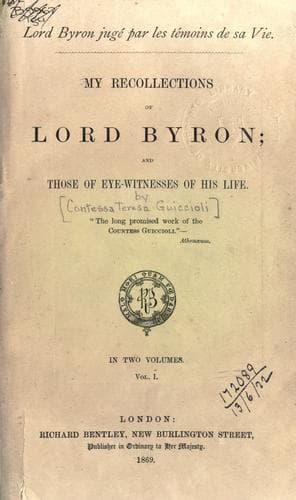
My Recollections of Lord ByronGuiccioli, Teresa, contessa di
General
My Recollections of Lord Byron
Guiccioli, Teresa, contessa di
Byron, George Gordon Byron, Baron, 1788-1824; Poets, English -- 19th century -- Biography
Thus, in his elegy upon the death of Thyrza, "far too beautiful," says
Moore, "and too pure to have been inspired by a mortal being," what
pathos, what sensitiveness! What charm in his sonnets to Guinevre! What
soft melancholy, what profound and intimate knowledge of the immortality
and spirituality of our soul, in his Hebrew melodies! "They seem as
though they had been inspired by Isaiah and written by Shakspeare," says
the Very Rev. Dr. Stanley, Dean of Westminster. What touching family
affection in his domestic poems, and what generosity in the avowal of
certain wrongs! What great and moral feeling pervade the two last cantos
of "Childe Harold," melancholy though they be, like all things which are
beautiful! How one feels that the pain they tell of has its origin in
unmerited persecution, and how his intellect came to his aid, and
enabled him to bear with calmness the uncertainties incident to our
nature! What greatness of soul in the forgiveness of what to others
would seem unpardonable! What love of humanity and of its rights! What
hatred of injustice, tyranny, and oppression in the "Ode to Venice," in
"The Lament of Tasso," in "The Prophecy of Dante," and in general in all
his latter poems, even in the "Isle," a poem little known, which was
written a short time before he left Genoa for Greece. Here, more than in
any other of his poems, we see the admirable peace of mind which he had
created for himself, and how far too high his great intellect soared to
be any longer moved by the world's injustice.
Quotations from his poems would be impossible. How choose without
regretting what has been discarded? They must be read; and those must be
pitied who do not feel morally better after having read them.
This is precisely what has been least done up to the present time:
people have been content with reading his early poems, and with seeking
Byron in "Childe Harold" or in the heroes of his Oriental poems; which
is about as just as to look for Shakspeare in Iago, Milton in Satan,
Goethe in Mephistopheles, or Lamartine in the blasphemies of his ninth
Meditation.
Public-domain text, read in full here on John Shaqi.
Reviews
Reviews
No reviews yet
Be the first to share your thoughts on this work.
Join the Discussion
Join the discussion
Sign in to leave a comment or review.
Sign InorCreate an account