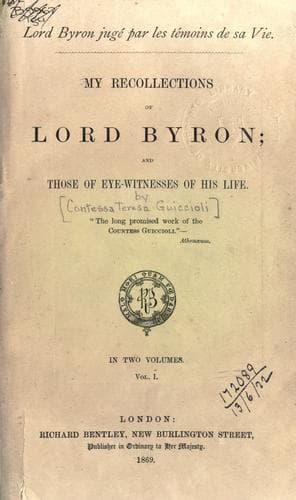
My Recollections of Lord ByronGuiccioli, Teresa, contessa di
General
My Recollections of Lord Byron
Guiccioli, Teresa, contessa di
Byron, George Gordon Byron, Baron, 1788-1824; Poets, English -- 19th century -- Biography
Thus French critics,--disposed to identify the man with the imaginary
beings of his poems, and neglecting to seek him where they could have
found him, relying upon judgments formed in England, and too often by
people prejudiced against Byron,--have themselves adopted false views
with respect to the author and his works. Thus, again, poetry--which
without any preconceived teaching or any particular doctrine of its own,
without transgressing the rules laid down by art, moved the soul,
purified and elevated it, and taught it to despise the base and cowardly
desires of nature, and excited in it the admiration of all that is noble
and heroic,--was declared to be suspicious even in France, because too
often it had proclaimed openly the truth where one would have wished
truth to have been disguised. Many would fain have thought otherwise,
but they preferred remaining silent, and to draw from that poetry the
poetical riches of which they might be in want.
Our intention being to consecrate a chapter to the examination of the
moral tendency of Byron's poetry, we will not now say more. We must add,
however, that these views which had been so easily adopted in France
were not those of the majority of right-thinking persons in England,
although they dared not proclaim their opinions then as they can now.
I shall only quote the opinion of two Englishmen of great merit (Moore
and Sir Egerton Brydges), who can neither one nor the other be suspected
of partiality; the first, on account of his great fear of ever wounding
the susceptibilities of his countrymen, the other by the independence
and nobility of his character.
"How few are the pages in his poems," says Moore, "even if perused
rapidly, which by their natural tendency toward virtue, or some splendid
tribute to the greatness of God's works, or by an explosion of natural
piety more touching than any homily, do not entitle him to be admitted
in the purest temple of which Christianity may have the keep!"--_Moore_,
vol. ii.
Sir Egerton Brydges, after having fully appreciated the poems of Lord
Byron, says:----
"They give to the reader's best instincts an impulse which elevates,
purifies, instructs, charms, and affords us the noblest and purest of
joys."--_Sir E. Brydges_, vol. x. p. 141.
These quotations perhaps will be found too many, but are they not
necessary? Is truth which can be so easily changed equally easy to
re-establish? Are not a thousand words wanted to restore a reputation
which a light word or, may be, slight malice has tarnished? If the
author of these pages only expressed individual opinions without
adducing any proof, that is to say, without accompanying them with the
disinterested and enlightened testimonies of people who have known Byron
personally, these volumes might gain in interest by being condensed in a
shorter space.
Public-domain text, read in full here on John Shaqi.
Reviews
Reviews
No reviews yet
Be the first to share your thoughts on this work.
Join the Discussion
Join the discussion
Sign in to leave a comment or review.
Sign InorCreate an account