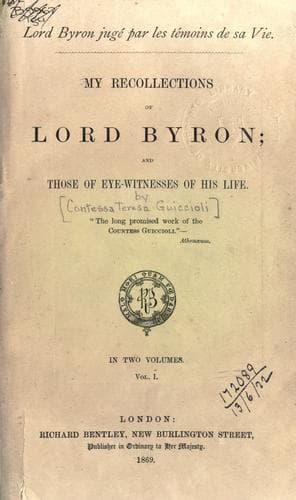
My Recollections of Lord ByronGuiccioli, Teresa, contessa di
General
My Recollections of Lord Byron
Guiccioli, Teresa, contessa di
Byron, George Gordon Byron, Baron, 1788-1824; Poets, English -- 19th century -- Biography
But in shortening the road would the author attain the desired end?
would the self-imposed task be fulfilled? would his or her own
convictions become those of others? Should not authors sacrifice
themselves to their subject in all works inspired by a devoted spirit?
Shall it be said that oftentimes one has wished to prove what had
already been conceded by every body? that the value of the proofs
adduced is lessened by the fact that they are nearly all already known?
In answer, and without noticing the words "nearly all," he might say
that, as truth has several aspects, one may almost, without mentioning
new facts, arrive at being what might be called the guide in the tour
round the soul, and fathom its depth in search of the reality; just as
when we have looked at all the sides of a picture, we return to it, in
order to find in it fresh beauties which may have escaped our notice on
a first inspection. There are certain souls, to fathom which it is
absolutely necessary to employ a retrospective method; in the same way
that the pictures, for instance, of Salvator Rosa enchant on close
inspection of the great beauties which in some lights seem hid by a mass
of clouds.
"One can hardly employ too many means," says Ste. Beuve, "to know a man;
that is, to understand him to be something more than an intellectual
being. As long as we have not asked ourselves a certain number of
questions about such and such an author, and as long as they have not
been satisfactorily answered, we are not sure of having completely made
him out, even were such questions to be wholly irrelevant to the
subjects upon which he has written.
"What did he think upon religious matters?
"How did the aspect of nature affect him?
"How did he behave in regard to women?
"How about money?
"What rules did he follow?
"What was his daily life? etc., etc.
"Finally, what was his peculiar vice and foible? Every man has one.
"Not one of these questions is unimportant in order to appreciate an
author or his book, provided the book does not treat of pure
mathematics; and especially if it is a literary work, that is to say, a
book wherein there is something about every thing."[3]
Be this opinion of an eminent critic our rule and an encouragement to
our efforts.
We are well aware that in France, now-a-days, writers do not like to use
the same materials in describing a character as are used by other
nations, and especially by England. A study of this kind in France must
not be a judgment pronounced upon the individual who is the object of
it, and still less an inquiry. The qualities and defects of a man of
genius do not constitute the principal business of the artist. Man is
now rather examined as a work of art or as an object of science. When
reason has made him out, and intellectual curiosity has been satisfied,
the wish to understand him is not carried out further. The subject is
abandoned, lest the reader may be tired.
Public-domain text, read in full here on John Shaqi.
Reviews
Reviews
No reviews yet
Be the first to share your thoughts on this work.
Join the Discussion
Join the discussion
Sign in to leave a comment or review.
Sign InorCreate an account