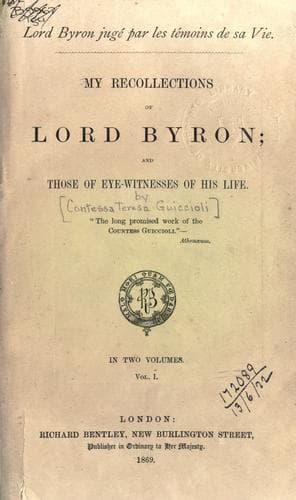
My Recollections of Lord ByronGuiccioli, Teresa, contessa di
General
My Recollections of Lord Byron
Guiccioli, Teresa, contessa di
Byron, George Gordon Byron, Baron, 1788-1824; Poets, English -- 19th century -- Biography
This may be good reasoning in many cases; but in the present perhaps the
best rule is "in medio tutissimus." When a good painting is spoilt by
overpolish, to wash the polish off is not to restore it to its former
appearance. To arrive at this last result, however, no pains should be
spared; and upon this principle we must act with regard to Byron. In
psychological studies the whole depends upon all the parts, and what may
at first seem unimportant may prove to be the best confirmation of the
thesis. To be stopped by details (I might almost say repetitions) would
therefore be to exhibit a fear in adducing proof.
Can it be said that we have not sufficiently condemned? To add this
interest to the volume would not have been a difficult task.
To attack is easier than to defend; but we should then have had to
invent our facts, and, at the same time, to add romance to history.
The world, says a great moralist of our times, prefers a vice which
amuses it rather than a virtue which bores it; but our respect for the
reader convinces us that the adoption of such a means of arriving at
success would forfeit their respect for us and be as repugnant to their
sense of justice as to our own. As regards Byron, the means have more
than once been employed, and with the more success by those who have
united to their skill the charms of style.
But in claiming no talent, no power to interest, and in refusing to
appear as an author from motives of pusillanimity, idleness, or
self-love, is one less excusable for hiding the truth when one is
acquainted with it?
If it is the duty of a man of honor and a Christian to come to the
rescue of a victim to violence when it is in one's power, is it not
incumbent upon one to raise a voice in the defense of those who can no
longer resent an insult, when we know that they are wrongly accused? To
be silent under such circumstances would be productive of remorse; and
the remorse is greater when felt on the score of those whose genius
constitutes the monopoly of the whole world, and forms part of the
common treasure of humanity, which enjoins that it should be respected.
Is not their reputation a part of the inherited treasure? To allow such
reputation to be outraged would, in our minds, be as culpable as to hide
a portion of a treasure which is not our own.
"Truth," says Lamartine, "does not require style. Its light shines of
itself; its appearance is its proof."
Public-domain text, read in full here on John Shaqi.
Reviews
Reviews
No reviews yet
Be the first to share your thoughts on this work.
Join the Discussion
Join the discussion
Sign in to leave a comment or review.
Sign InorCreate an account