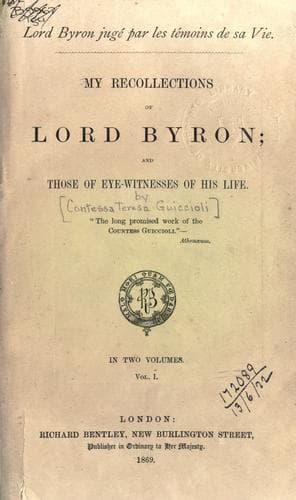
My Recollections of Lord ByronGuiccioli, Teresa, contessa di
General
My Recollections of Lord Byron
Guiccioli, Teresa, contessa di
Byron, George Gordon Byron, Baron, 1788-1824; Poets, English -- 19th century -- Biography
It is known that many licentious writers have led very regular and
chaste lives; that many who have sung their success with women have not
dared to declare their love to one woman; that all Sterne's sentiment
was perfectly ideal, and proceeded always from the head and never from
the heart; that Seneca's morality was no barrier to his practicing
usury; and that, according to Plutarch, Demosthenes was a very
questionable moralist in practice. Why, then, necessarily conclude that
a moralist is a moral man, or a sarcastic satirist a deceitful one, or
the man who describes scenes of blood and carnage a monster of cruelty?
Does not Montaigne say of authors that they must be judged by their
merits, and not by their morals, nor by that show of works which they
exhibit to the world? Why, then, does M. Lamartine appreciate Byron
according to his satirical works, when all those who knew him assert
that his real character was very different to his literary one? He did
not personify, but create his heroes; which are two very different
things.
Like Salvator Rosa, who, the meekest of men in private life, could only
find a vent to his talent by painting scenes of brigandage and horror,
so did Byron's genius require to go down into the darkest recesses of
the passions which generate remorse, crime, and heroism, to find that
spark which fired his genius. But it must be owned, that even his great
qualities were causes of the false judgment of the world upon him. Thus,
in describing Childe Harold, he no doubt wished to paint a side of
nature which had not yet been seen. At the scenes of despair, at the
scenes of doubt which assail him, the poet assists rather as the
historian than as the actor. And the same holds good for other poems,
where he describes those peculiar diseases of the mind which great
geniuses alone can comprehend, though they need not have experienced
them. But it was the very life which he infused into his heroes that
made it appear as if they could not personify any one but himself. And
as to their faults, because he was wont to give them his qualities, it
was argued, that since the latter were observable to be common to the
author and the creations of his fancy, the faults of these must likewise
be his. If only the faults, why not also the crimes? Thus it came that,
caring little for their want of argument, Byron's enemies erected
themselves into avengers of too much talent bestowed upon one single
man.
Public-domain text, read in full here on John Shaqi.
Reviews
Reviews
No reviews yet
Be the first to share your thoughts on this work.
Join the Discussion
Join the discussion
Sign in to leave a comment or review.
Sign InorCreate an account