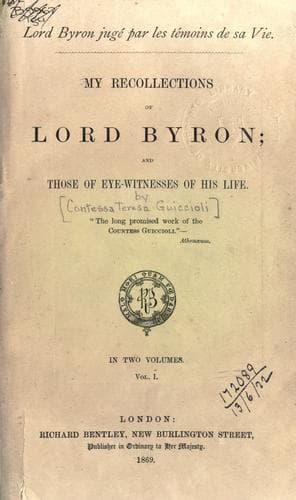
My Recollections of Lord ByronGuiccioli, Teresa, contessa di
General
My Recollections of Lord Byron
Guiccioli, Teresa, contessa di
Byron, George Gordon Byron, Baron, 1788-1824; Poets, English -- 19th century -- Biography
Byron might have taken up his own defense, but did not care to do so, or
did it carelessly in some letters written to intimate friends. To Moore
he wrote:--"Like all imaginative men, I, of course, embody myself with
the character while I draw it; but not a moment after the pen is from
the paper." He always, however, begged that he might be judged by his
acts; and a short time before he died at Missolonghi, after recommending
Colonel Stanhope to desist from then pressing the necessity of giving
liberty to the press, and from recommending the works of Bentham to a
people who could not even read, Byron replied to the colonel's rather
hasty remarks, "Judge me by my acts." This request he had often
repeated, as his life was not one of those which fear the light of day.
All in vain. His enemies were not satisfied with this means of putting
an end to their calumnies.
Where does M. de Lamartine find the truth which he proposes to tell the
world about Byron? Not surely among the writers whose biographies of
Byron were either works of revenge or of speculation, and sometimes
both. Not in the conversations which Byron had with several people, and
on the credulity of whom he loved to speculate. It can not, therefore,
be in the biographies of men who have written erroneously, and have not
understood their subject; but in Moore, in Parry, in Count Gamba's
works, and, may be, in a few others. I am, however, far from saying,
that Moore has acted toward Lord Byron with all that friendly feeling
which Byron recommended to him on asking him to write the Life of
Sheridan, "without offending the living or insulting the dead." Quite
the contrary. I take it that Moore has wholly disregarded his duties as
a true friend, by publishing essentially private letters, by introducing
into his books certain anecdotes which he might, if even they were true,
have advantageously left out; and in failing, from fear of wounding
living susceptibilities, to assert with energy that which he knew to be
the real case with Byron. More than any one, Moore experienced the fatal
influence which injures independence in aristocratic England. An
Irishman by birth, and a commoner, Moore was flattered to find himself
elevated by his talents to a position in aristocratic circles which he
owed to his talents, but which he was loath to resign. The English
aristocracy then formed a kind of clique whose wish it was to govern
England on the condition that its secret of governing should not be
revealed, and was furious with Byron, who was one of them, for revealing
their weaknesses and upbraiding their pretensions. Moore wished to live
among the statesmen and noblemen whose despotic views and bad policy
Byron had openly condemned, and among those lovely islanders in whose
number there might be found more Adelinas than Auroras, and to whom
Byron had preferred foreign beauties. Moore, in short, wished to live
with the literary men whom Byron had ridiculed in his satires, and among
Public-domain text, read in full here on John Shaqi.
Reviews
Reviews
No reviews yet
Be the first to share your thoughts on this work.
Join the Discussion
Join the discussion
Sign in to leave a comment or review.
Sign InorCreate an account