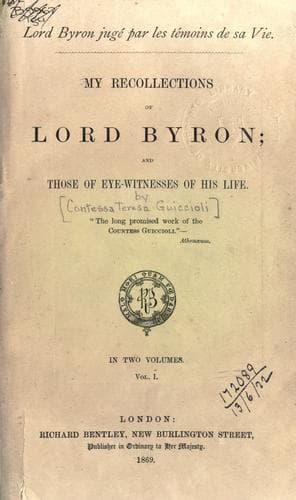
My Recollections of Lord ByronGuiccioli, Teresa, contessa di
General
My Recollections of Lord Byron
Guiccioli, Teresa, contessa di
Byron, George Gordon Byron, Baron, 1788-1824; Poets, English -- 19th century -- Biography
the high clergy, then as intolerant as they were hypocritical, and who,
as Byron said, forgot Christ alone in their Christianity. Moore, whose
necessity it had become to live among these open revilers and enemies of
Byron, after allowing the memoirs of Byron to be burnt, because in them
some of the above-named personages were unmasked, this Moore was weak
enough not to proclaim energetically that Byron's character was as great
as his genius, but to do so only timidly. By way of obtaining pardon
even for this mite of justice to the friend who was gone, Moore actually
condescended to associate himself with those who pleaded extenuating
circumstances for Byron's temper, like Walter Scott and other poets. But
truth comes out, nevertheless, in Moore; and in the perusal of Byron's
truthful and simple letters we find him there displayed in all his
admirable and unique worth as an intellectual and a moral man. We find
him adorned with all the virtues which Heaven gave him at his birth; his
real goodness, which neither injustice nor misfortune could alter; his
generosity, which not only made him disbelieve in ingratitude, but
actually incited him to render good for evil and obliged him to own that
"he could not keep his resentments;" his gratitude for the little that
is done for him; his sincerity; his openness of character; his greatness
and disinterestedness. "His very failings were those of a sincere, a
generous, and a noble mind," says a biographer who knew him well. His
contempt for base actions; his love of equity; his passion for truth,
which was carried almost to a hatred of cant and hypocrisy, were the
immediate causes of his want of fairness in his opinion of himself and
of his self-accusation of things most contrary to his nature.
So singular a trait in his character was by no means the result of
eccentricity, but the result of an exceptional assembly of rare
qualities which met for the first time in one man, and which, shining in
the midst of a most corrupt society, constituted almost more an anomaly
which became a real defect, hurtful, however, to himself only. His ideal
of the beautiful magnified weaknesses into crimes, and physical failings
into deformities. Thus it is that with the saints the slightest
transgression of the laws appears at once in the light of mortal sin.
St. Augustin calls the greediness of his youth a crime. The result of
all this was that his very virtues mystified the world and caused it to
believe that the faults which he attributed to himself were nothing in
comparison of those which he really had.
Public-domain text, read in full here on John Shaqi.
Reviews
Reviews
No reviews yet
Be the first to share your thoughts on this work.
Join the Discussion
Join the discussion
Sign in to leave a comment or review.
Sign InorCreate an account