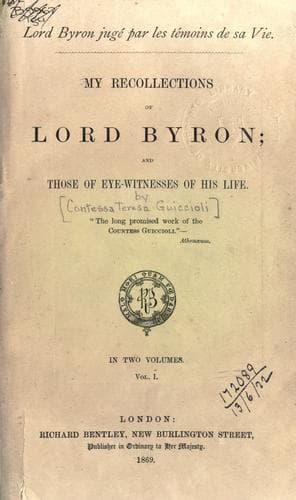
My Recollections of Lord ByronGuiccioli, Teresa, contessa di
General
My Recollections of Lord Byron
Guiccioli, Teresa, contessa di
Byron, George Gordon Byron, Baron, 1788-1824; Poets, English -- 19th century -- Biography
Byron, however, was indignant at being so unfairly treated. He treated
with contempt the men who calumniated him, and as if they were idiots.
He can safely, therefore, be blamed for not urging enough his own
defense. This, to my mind, constitutes his capital fault, unless one
considers defects of character those changes of humor which rapidly
passed from gayety to melancholy, or his pretended irritability, which
was merely a slight disposition to be impatient. These were all the
result of his poetical nature, added to the effects of early education
and to those of certain family circumstances. It would be too hard and
too unfair to attribute these slight weaknesses of character proper to
great genius to a bad nature or to misanthropy.
Had Lord Byron not been impatient he must have been satisfied with his
own condition and indifferent to that of others. In other words, he must
have been an egotist, which he was not. He was gay by nature, and
repeatedly showed it; but he had been sorely wounded by the injustice of
men, and his marriage with Miss Milbank had undermined his peace and
happiness. How, then, could he escape the occasional pangs of grief, and
not betray outwardly the pain which devoured him inwardly. In such
moments it was a relief to him to heave a sigh, or take up a pen to vent
his grief in rhyme. His misanthropy was quite foreign to his nature. All
those who knew him can bear testimony to the falseness of the
accusation.
Moore, who knew him so well, and who always speaks the truth when no
longer under the influences which at times overpower him, after speaking
of the charm of Byron's manner when he saw him for the first time, ends
by saying: "It may be asserted that never did there exist before, and it
is most probable never will exist again, a combination of such vast
mental power and surpassing genius, with so many others of those
advantages and attractions by which the world is in general dazzled and
captivated."
When, therefore, M. de Lamartine seeks the truth in Moore, Parry, and
some other biographers respecting Byron, he will find that this
eminently beautiful form was in harmony with the splendid intellect and
moral qualities of the man. M. de Lamartine will see that Byron was a
good and devoted son, a tender father and brother, a faithful friend,
and indulgent master, beloved by all who ever knew him, and who was
never accused, even by his enemies, of having tried to seduce an
innocent young girl, or having disturbed the peace of conjugal bliss. He
will behold his charity, which was universal and unbounded; a pride
which never stooped to be subservient of those in power; a firm
political faith; a contempt of public dignities, so far as they
reflected glory upon himself; and such a spirit of humility that he was
ever ready to blame himself and follow the advice of those whom he
deemed to be animated by no hostile spirit against himself.
Public-domain text, read in full here on John Shaqi.
Reviews
Reviews
No reviews yet
Be the first to share your thoughts on this work.
Join the Discussion
Join the discussion
Sign in to leave a comment or review.
Sign InorCreate an account