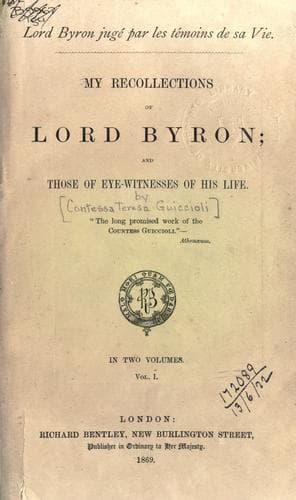
My Recollections of Lord ByronGuiccioli, Teresa, contessa di
General
My Recollections of Lord Byron
Guiccioli, Teresa, contessa di
Byron, George Gordon Byron, Baron, 1788-1824; Poets, English -- 19th century -- Biography
When M. de Lamartine sees all this, not merely written down as in these
pages, but actually proved by facts and irrefutable testimonies, his
loyal soul must revolt and wish to do justice to himself by rejecting
his former opinions. He will understand that if he himself has been
called a drinker of blood by the party whom he styles bigoted and
composed of old men, Byron, too, may have been calumniated. Looking,
then, at the great poet in his proper light, that is, in the plenitude
of his rare qualities, and considering him under each of the
circumstances of his life, M. de Lamartine will own that he had
misunderstood that most admirable of characters, and grant that the
"satanic laughter" of which he spoke was, on the contrary, the smile
which was so beautiful that it might have lighted up by its magic soft
rays the dark regions of Satan. His doubts being cleared away, M. de
Lamartine will end by saying that Byron was an "angel, not a demon."
Byron's misfortune was to have been born in the England of those days.
Do you remember his beautiful lines in the "Due Foscari?"--
"He might have lived,
So formed for gentle privacy of life,
So loving, so beloved; the native of
Another land, and who so bless'd and blessing
As my poor Foscari? Nothing was wanting
Unto his happiness and mine save not
To be Venetian."
In writing these lines Byron must have thought of his own fate. He was
scarcely British by origin, and very little so by his turn of mind, or
by his tastes or by the nature of his genius. "My ancestors are not
Saxon, they are Norman," he said; "and my blood is all meridian."
If, instead of being born in England then, he had come before the world
when his star would have been hailed with the same love and regard that
was granted to Dante in Italy, to Chateaubriand and Lamartine in France,
or to Goethe in Germany, who would ever have blamed him for the slight
errors which fell from his pen in "Don Juan,"--a poem written hastily
and with carelessness, but of which it can be said, as Montesquieu said
of the prettiest women, "their part has more gravity and importance than
is generally thought." If the sense of the ridiculous is ever stronger
among people whose appreciation of the beautiful is keenest, who more
than Byron could have possessed it to a higher degree? Is it therefore
to be marvelled at that, in order to make the truth he revealed
accessible to all, and such whose minds had rusted in egotism and
routine, he should have given to them a new and sarcastic form?
Public-domain text, read in full here on John Shaqi.
Reviews
Reviews
No reviews yet
Be the first to share your thoughts on this work.
Join the Discussion
Join the discussion
Sign in to leave a comment or review.
Sign InorCreate an account