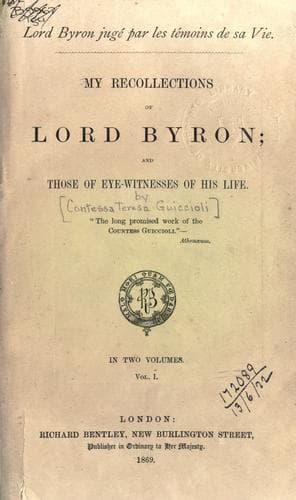
My Recollections of Lord ByronGuiccioli, Teresa, contessa di
General
My Recollections of Lord Byron
Guiccioli, Teresa, contessa di
Byron, George Gordon Byron, Baron, 1788-1824; Poets, English -- 19th century -- Biography
Had he been born anywhere but in the England of those days, he never
would have been accused of mocking virtue because he claimed for it
reality of character, and not that superficial form which he saw existed
then in society. He believed it right to scorn the appearances of virtue
put on only for the purpose of reaping its advantages. No one respected
more than he did all that was really holy, virtuous, and respectable;
but who could blame him for wishing to denounce hypocrisy? As for his
supposed skepticism, and his expressions of despair, they may be classed
with the misgivings of Job, of Pascal, of Lamartine, of Chateaubriand,
and of other great minds, for whom the unknown world is a source of
constant anxiety of thought, and whose cry of despair is rather a
supplication to the Almighty that He would reveal himself more to their
eyes. It must be borne in mind that the skepticism which some lines in
his poems denounce is one of which the desponding nature calls more for
our sympathy than our denunciations, since "we discover in the midst of
these doubts," says Moore, "an innate piety which might have become
tepid but never quite cold." His own words should be remembered when he
writes, as a note to the two first cantos of "Childe Harold," that the
spirit of the stanzas reflects grief and illness, more than an obstinate
and mocking skepticism; and so they do. They do not embody any
conclusions, but are only the expression of a passionate appeal to the
Almighty to come to the rescue and proclaim the victory of faith.
Could any thing but a very ordinary event be seen in his separation from
a wife who was in no way suited to him, and whose worth can be esteemed
by the remark which she addressed to Byron some three weeks after her
marriage: "When, my lord, do you intend to give up your habit of
versifying?" And, alas! could he possibly be happy, born as he was in a
country where party prejudices ran so high? where his first satire had
created for him so many enemies? where some of his poems had roused
political anger against him, and where his truth, his honesty, could not
patiently bear with the hypocrisy of those who surrounded him, and
where, in fact, he had had the misfortune to marry Miss Milbank?
The great minds whom God designs to be the apostles of truth on earth,
make use for that purpose of the most efficacious means at their
disposal. The universal genius of Byron allowed of his making use of
every means to arrive at his end. He was able to be at once pathetic,
comic, tragical, satirical, vehement, scoffing, bitter, and pleasant.
This universality of talents, directed against Englishmen, was injurious
to his peace of mind.
When Byron went to Italy his heart was broken down with real and not
imaginary sorrows. These were not of that kind which create perfection,
but were the result of an unheard-of persecution on account of a family
difference in which he was much more the victim than the culprit.
Public-domain text, read in full here on John Shaqi.
Reviews
Reviews
No reviews yet
Be the first to share your thoughts on this work.
Join the Discussion
Join the discussion
Sign in to leave a comment or review.
Sign InorCreate an account