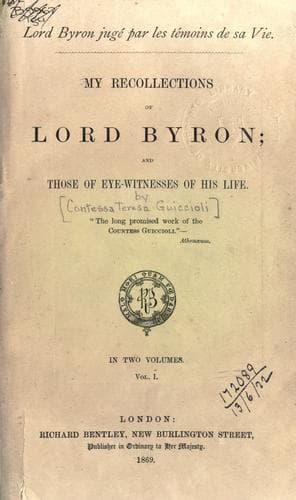
My Recollections of Lord ByronGuiccioli, Teresa, contessa di
General
My Recollections of Lord Byron
Guiccioli, Teresa, contessa di
Byron, George Gordon Byron, Baron, 1788-1824; Poets, English -- 19th century -- Biography
He required to live in a milder climate, and a softer atmosphere to
breathe in. He found both at Venice; and under their influence his mind
took a new turn, which had remained undeveloped while in his own clouded
country.
In the study of Italian literature he met with the Bernesque poetry,
which is so lightly and elegantly sarcastic. He made the acquaintance of
Buratti, the clever and charming satirist. He began, himself, to
perceive the baseness of men, and found in an aesthetical mockery of
human failings the most copious of the poetical currents of his mind.
The more his friends and his enemies told him of the calumnies which
were uttered against him, so much the more did Byron's contempt swell
into disdain; and to this circumstance did "Beppo" and "Don Juan" _owe_
their appearance.
The social condition of his country and the prevalent cant opened to him
a field for reflection at Venice, where customs were so different and
manners so tolerant. Seeing new horizons before him, he was more than
ever disgusted at the judgments of those who calumniated him, and ended
by believing it to be best to laugh at their silly efforts to ruin him.
He then wrote "Beppo" and afterward "Don Juan."
He was mistaken, however, in believing that in England this new style of
poetry would be liked. His jests and sarcasms were not understood by the
greater portion of those against whom they were levelled. The nature of
the Bernese poetry being essentially French, England could not, with its
serious tendencies, like a production in which the moral purpose was
artistically veiled. From that day forward a severance took place
between Byron and his countrymen. What had enchanted the French
displeased them, and Byron in vain translated the "Morgante" of Pulci,
to show them what a priest could say in that style of poetry in a
Catholic country. In vain did he write to his friends that "Don Juan"
will be known by-and-by for what it is intended,--a satire on the abuses
of the present state of society, and not a eulogy of vice. It may be now
and then voluptuous: I can't help it. Ariosto is worse; Smollett ten
times worse; Fielding no better. No girl will ever be seduced by reading
"Don Juan," etc.
But he was blamed just because he jested. To his ultramontane tone they
would have preferred him to blaspheme in coarse Saxon.
One of the best of Byron's biographers asserts that he was a French mind
lost on the borders of the Thames. Lord Byron had every kind of mind,
and that is why he was equally French. But in addressing his countrymen,
as such, he heaped a mountain of abuse upon his head.
With the most moral portion of the English public a violent satire would
have had better chance of success. With the higher classes the work was
read with avidity and pleasure. It was not owned, because there were too
many reasons for condemning it; but it found its way under many a
pillow, to prove to the country how virtue and patriotism were
endangered by this production.
Public-domain text, read in full here on John Shaqi.
Reviews
Reviews
No reviews yet
Be the first to share your thoughts on this work.
Join the Discussion
Join the discussion
Sign in to leave a comment or review.
Sign InorCreate an account