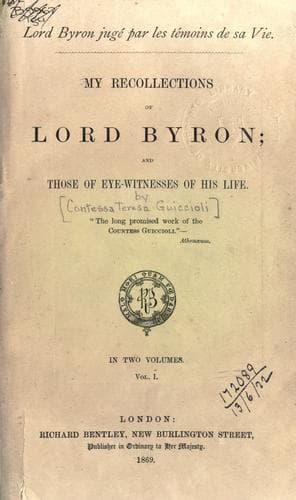
My Recollections of Lord ByronGuiccioli, Teresa, contessa di
General
My Recollections of Lord Byron
Guiccioli, Teresa, contessa di
Byron, George Gordon Byron, Baron, 1788-1824; Poets, English -- 19th century -- Biography
Murray made himself the echo of all this wrath, and Lord Byron, not able
at times to contain his, wrote to him much to the following purpose--
"I intend to write my best work in Italian, and I am working at it. As
for the opinion of the English, which you mention, let them know how
much it is worth before they come and insult me by their condescension.
"I have not written for their pleasure; if they find theirs in the
perusal of my works, it is because they wish it. I have never flattered
their opinion or their pride, nor shall I ever do so. I have no
intention either of writing books for women or to '_dilettar le femine e
la plese_.' I have written merely from impulse and from passion, and not
for their sweet voices. I know what their applause is worth; few writers
have had more. They made of me a kind of popular idol without my ever
wishing, and kicked me down from the pedestal upon which their caprice
had raised me. But the idol did not break in the fall, and now they
would raise it again, but they shall not." As soon as they saw that
Byron was perfectly happy in Italy, and that their abuse did him but
very little harm, they gave full vent to their rage.
They had shown how little they knew him when they identified him with
his heroes; they found that they knew even less of him when he appeared
to them in the reality of his character. Calumny followed upon calumny.
Unable to find him at fault, they interpreted his words themselves, and
gave them a different meaning. Every thing was figurative of some
wickedness, and to the simplest expressions some vile intention was
attributed.
They depreciated his works, in which are to be found such admirable and
varied types of women characters, that they even surpass in beauty those
of Shakspeare (Angiolina, Myrrha, Anna): they said that Faliero wanted
interest, that Sardanapalus was a voluptuary; that Satan in "Cain" did
not speak as a theologian (how could he?), that there were irreverent
tendencies in his sacred dramas--and finally that his declaration--
"My altars are the mountains and the ocean,
Earth, air, stars,--all that springs from the great Whole,
Who hath produced, and will receive the soul,"
was hazardous, and almost that of an atheist. Atheist! he! who
considered atheists fools.
On leaving Venice for Ravenna,[6] where he had spent a few months, only
by way of distraction in the midst of his sorrows and serious
occupations, he was accused of dissolute conduct; and the serious
attachment which he had wished to avoid, but which had mastered his
whole heart, and induced him to live an isolated life with the person he
loved in a town of Romagna, far from all that could flatter his vanity
and from all intercourse with his countrymen, was brought against him to
show that he lived the life of an Epicurean, and brought misery into the
heart of families.
Public-domain text, read in full here on John Shaqi.
Reviews
Reviews
No reviews yet
Be the first to share your thoughts on this work.
Join the Discussion
Join the discussion
Sign in to leave a comment or review.
Sign InorCreate an account