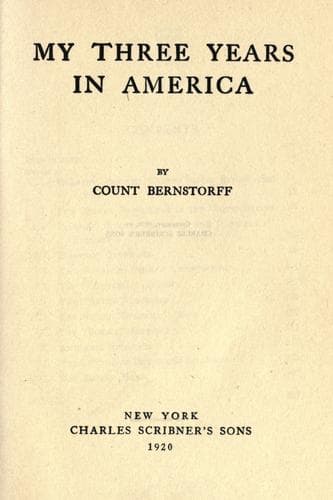
My Three Years in AmericaBernstorff, Johann Heinrich, Graf von
History
My Three Years in America
Bernstorff, Johann Heinrich, Graf von
Germany -- Foreign relations -- United States; United States -- Foreign relations -- Germany; World War, 1914-1918
German foreign policy had been ably conducted by Bismarck; but, in
keeping with the times, it had been almost exclusively Continental
and European. At the very moment when Bismarck withdrew from the arena,
Germany's era of world-politics began. It was not the free bloom of
our statesmen's own creative powers; but a bitter necessity, born
of the imperative need of providing Germany's increasing population
with sufficient foodstuffs. But it was not our world-politics, as
such, that brought about our downfall; but the way we set to work
in prosecuting our policy. The Triple Alliance, with its excellent
Reinsurance Treaty, did not constitute a sufficiently powerful
springboard from which to take our plunge into world-politics. The
Reinsurance contract could not be anything but a makeshift, which
merely deferred the inevitable choice which had to be made between
Russia and Austria-Hungary. In the course of time, we should either
have had to decide entirely in favor of Russia, in the manner outlined
above, or we should have had to try to come to an understanding with
England, upon terms which, at all events, we should not have been
at liberty to choose for ourselves. Unfortunately, however, it was
an axiom of post-Bismarckian German politics, that the differences
between Russia and England were irreconcilable, and that the Triple
Alliance would have to constitute the needle-index of the scales
between these two hostile Powers. This proposition was incessantly
contested both verbally and in writing by Herr von Holstein, who
was then the leading spirit at the Foreign Office. He perceived
that its chief flaw was the weak point in the Triple Alliance
itself,--that is to say, the differences between Austria-Hungary
and Italy on the one hand, and Italy's dependence upon England's
superior power in the Mediterranean on the other. Furthermore, he
recognized the prodigious possibility, which was not beyond the
art of English statesmanship, of a compromise between England and
Russia. He did not see, however, how the hostility of the French
to ourselves would serve as a medium for this universal coalition
against us.
In the last Entente Note of the Five-Years War there is the following
passage:
"For many years the rulers of Germany, true to the Prussian tradition,
strove for a position of dominance in Europe. They required that they
should be able to dictate and tyrannize to a subservient Europe,
as they dictated and tyrannized over subservient Germany."
Public-domain text, read in full here on John Shaqi.
Reviews
Reviews
No reviews yet
Be the first to share your thoughts on this work.
Join the Discussion
Join the discussion
Sign in to leave a comment or review.
Sign InorCreate an account