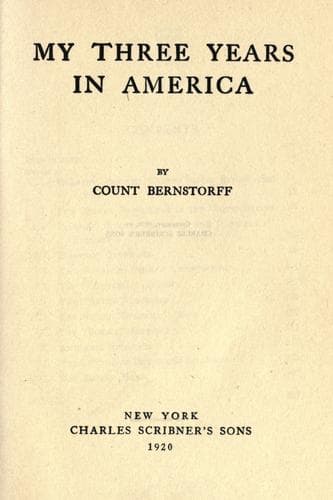
My Three Years in AmericaBernstorff, Johann Heinrich, Graf von
History
My Three Years in America
Bernstorff, Johann Heinrich, Graf von
Germany -- Foreign relations -- United States; United States -- Foreign relations -- Germany; World War, 1914-1918
We Germans know that this indictment is a lie; but unfortunately
all unprejudiced Germans must acknowledge that for years this lie
has been believed outside Germany. We, for our part, cherished
similar views about our enemies, nor did we make a sufficient effort
to dissipate their prejudices. On the contrary we constantly lent
color to them by means of the extravagant and high-flown speeches,
which formed the accompaniment to our world and naval policy, and
by means of our opposition to pacifism, disarmament, and arbitration
schemes, etc., etc. The extent to which our attitude at the Hague
Conference damaged us in the eyes of the whole world is no longer
a secret to anybody. As Heinrich Friedjung rightly observes:
"At the Hague Conference German diplomacy delivered itself up to
the vengeance of the pacifists, like a culprit."
During my tenure of office in Washington I succeeded on three occasions
in coming to an agreement with the Government there regarding the
terms of an arbitration treaty. All three treaties were, however,
rejected in Berlin, and consequently in America I never ceased from
being questioned reproachfully as to the reason why the United
States had been able to conclude arbitration treaties with every
other State in the world, but not with Germany.
The Entente Note, already quoted above, contained this further
statement:
"As soon as their preparations were complete, they encouraged a
subservient ally to declare war against Serbia at forty-eight hours'
notice, knowing full well that a conflict involving the control
of the Balkans could not be localized and almost certainly meant
a general war. In order to make doubly sure, they refused every
attempt at conciliation and conference until it was too late, and
the world war was inevitable for which they had plotted, and for
which alone among the nations they were fully equipped and prepared."
The leaders of the Entente Powers would like to exalt this distortion
of history into a dogma, in order that their various peoples may not
bring any unpleasant charges against them. And yet the historical
truth is already pretty clear to all who look for it honestly and
without prejudice. The German Government believed that the Serbian
propaganda would annihilate Austria-Hungary, and hoped, moreover,
that her last faithful ally would experience a political renaissance
as the result of her chastisement of Serbia. That is why they gave
Count Berchtold a free hand, in the belief that Count Bülow's success
over the Bosnian crisis could be repeated. Meanwhile, however, the
situation had changed. Russia and France, relying upon England's
help, wanted to risk a war. When the German Government saw this
they tried, like a driver of a car about to collide with another
vehicle, to jam on all breaks, and to drive backwards. But it was
then too late. The mistake our Government made was to consent to
Austria-Hungary's making so daring an experiment, at a moment of
such critical tension.
Public-domain text, read in full here on John Shaqi.
Reviews
Reviews
No reviews yet
Be the first to share your thoughts on this work.
Join the Discussion
Join the discussion
Sign in to leave a comment or review.
Sign InorCreate an account