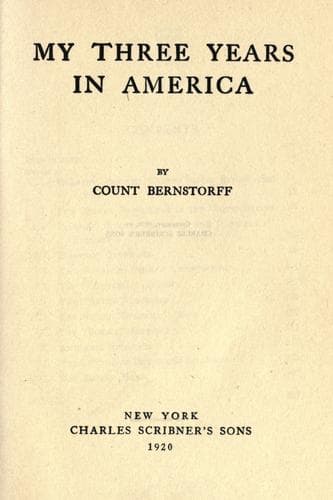
My Three Years in AmericaBernstorff, Johann Heinrich, Graf von
History
My Three Years in America
Bernstorff, Johann Heinrich, Graf von
Germany -- Foreign relations -- United States; United States -- Foreign relations -- Germany; World War, 1914-1918
He certainly tries to direct and influence public opinion. But he
changes his front at once if he notices that he has strayed from
the way that the _aura popularis_ would have him follow. In order
to form a correct judgment of Mr. Wilson's actions and speeches
it is always necessary to ask oneself, in the first place, what
end he has in view for his own political position and that of his
party in America. He proclaims in a most dazzling way the ideals
of the American people. But their realization always depends on
his own actual political interests and those of the Democratic
party. Mr. Wilson's attitude has always been synonymous with that
of his party, because the latter can produce no other personality
capable of competing with the President. Therefore, Mr. Wilson
always met with little or no opposition within the Democratic party,
and he was able to follow for a long time his own inclination to
adopt a quite independent policy.
Socially the President is very congenial when once he has made up
his mind to emerge from his narrow circle. He has not the reputation
of being a loyal friend, and is accused of ingratitude by many of
his former colleagues and enthusiastic adherents. In any case,
however, Mr. Wilson is an implacable enemy when once he feels himself
personally attacked or slighted. As a result of his sensitiveness
he has a strong tendency to make the mistake of regarding political
differences of opinion as personal antipathy. The President has
never forgiven the German Government for having caused the failure
of his peace-policy of 1916-17, which was supported by public opinion
in America. In Germany his later speeches, in which he drew a
distinction between the German people and the Imperial Government,
were regarded as hypocrisy. Such a differentiation was at that
time based on American public feeling, which held autocracy and
militarism responsible for the disasters which had been brought
upon the world. The question has, however, never been answered
why this distinction was abandoned by Mr. Wilson at Versailles.
Without wishing in any way either to accuse or defend him I consider
the answer to this riddle to be that the President allowed himself to
be convinced of the complicity of the German people by the statesmen
of the Entente. He was at the time in a mood with regard to us which
predisposed him to such influences. Mr. Wilson was by origin,
up-bringing and training a pacifist. When it is remembered that
with us and in neutral countries it was the pacifists themselves
who were the most indignant at the Peace of Versailles, that they
were the very people who for the most part advised against the
signature of this peace, one can imagine the feelings aroused in
a disillusioned pacifist like Wilson by those whom he regards as
responsible for having thwarted the possibility of an ideal pacifist
peace.
Public-domain text, read in full here on John Shaqi.
Reviews
Reviews
No reviews yet
Be the first to share your thoughts on this work.
Join the Discussion
Join the discussion
Sign in to leave a comment or review.
Sign InorCreate an account