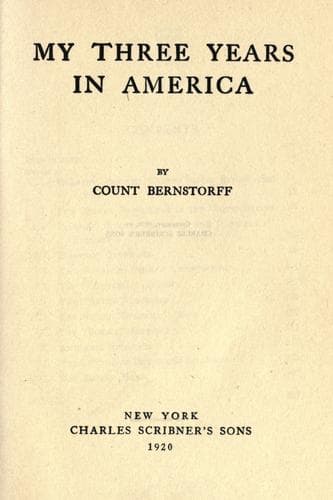
My Three Years in AmericaBernstorff, Johann Heinrich, Graf von
History
My Three Years in America
Bernstorff, Johann Heinrich, Graf von
Germany -- Foreign relations -- United States; United States -- Foreign relations -- Germany; World War, 1914-1918
It is not true either that we were thoroughly equipped and prepared
for war. We had neither sufficient supplies of munitions, foodstuffs
and raw materials, nor any plan of campaign for a war with England.
Be this as it may, we should not have been defeated if we had abided
firmly by our defensive policy. The heroic spirit displayed by
the German people surpassed all bounds, and they believed quite
honestly that they were fighting a war of defence. If our policy
had been conducted with corresponding consistency we should have
saved our position in the world. We ought always to have borne in
mind the analogy of the Seven Years War, in order to have been
ready at any moment to extricate ourselves from the hopeless business
with the least possible amount of loss.
After the first battle of the Marne, President Wilson consistently
maintained that a decision was no longer possible by force of arms.
This view, which I also shared, gave us some common ground, upon
which, despite our other differences, we were able to some extent
to work together.
Regarding Dr. Wilson's personality certain doubts have been and
are still entertained by many people. He is the most brilliant
and most eloquent exponent of the American point of view. But he
does not devote the same energy and consistency to the execution
of his various programmes as he does to their formation. There
can be no question that, as a result both of his origin and his
training, the President is very much under the sway of English
thought and ideals. Nevertheless, his ambition to be a Peacemaker
and an _Arbiter Mundi_ certainly suggested the chance of our winning
him over to our side, in the event of our being unable to achieve
a decisive victory with the forces at our disposal. In this case,
Wilson, as the democratic leader of the strongest neutral Power,
was the most suitable person to propose and to bring about a Peace
by arrangement.
After the opening of the U-boat campaign, two alternatives remained
open to us, one of which we were compelled to choose. If the prospects
of a U-boat war promised to secure a victory, it was naturally
incumbent upon us to prosecute it with all possible speed and energy.
If, as I personally believed, the U-boat war did not guarantee a
victory, it ought, owing to the enormous amount of friction to
which it could not help giving rise, under all circumstances to
have been abandoned; for, by creating American hostility, it did
us more harm than good.
I, as the German Ambassador, in the greatest neutral State, with
the evidences of American power all about me, could not help feeling
it my duty to maintain our diplomatic relations with the United
States. I was convinced that we should most certainly lose the
war if America stepped in against us. And thus I realized ever
more and more the supreme importance of preventing this from taking
place.
Public-domain text, read in full here on John Shaqi.
Reviews
Reviews
No reviews yet
Be the first to share your thoughts on this work.
Join the Discussion
Join the discussion
Sign in to leave a comment or review.
Sign InorCreate an account