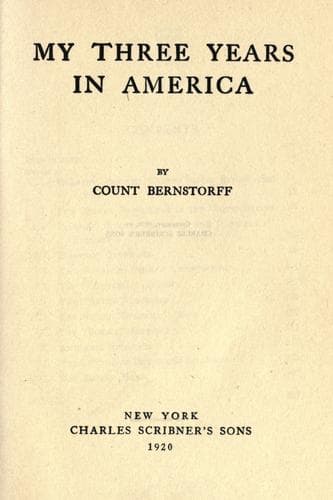
My Three Years in AmericaBernstorff, Johann Heinrich, Graf von
History
My Three Years in America
Bernstorff, Johann Heinrich, Graf von
Germany -- Foreign relations -- United States; United States -- Foreign relations -- Germany; World War, 1914-1918
My communications to the Central Government were framed with a
view to inducing them also to adopt this attitude; but they, of
course, had to form their conclusions, not from one source, but
from all the sources of information they possessed. At all events,
isolated as I was at Washington, I could not confine myself merely
to the task of furnishing my Government with information; but was
compelled on occasion to act on my own initiative, in order to
prevent any premature development in the diplomatic situation from
becoming utterly hopeless.
The policy for which I stood not only promised the negative success
of keeping America out of the war, but it also offered the only
prospect there was of obtaining, with neutral help, a Peace by
arrangement. My belief that such a peace could have been obtained
through Dr. Wilson is, of course, no longer susceptible of proof
to-day. It may perhaps sound improbable in view of the President's
behavior at Versailles. It is my opinion, however, that, previous
to the 31st of January, 1917, Dr. Wilson's attitude towards us
was radically different. I base my assumption that Wilson might
in those days have assisted us in obtaining a Peace by negotiation
upon the following points:
(1) A Peace by mediation was the only way in which the United States
could avoid becoming involved in the war, and this is what the
American public opinion of the day wished above all to prevent.
(2) It is true that even if he had wished to do so, Wilson could
not have declared war on England, neither could he by any exercise
of force have prevented the delivery of munitions to the Allies, or
have compelled England to observe the rights of nations. He could,
however, have obliged England to conclude a Peace by arrangement
with us; not only because in so doing he would have had the support
of American public opinion, but also because such a policy was in
keeping with the best political interests of the United States.
I therefore pursued the policy of Peace with undeviating consistency,
and to this day I still believe it to have been the only right
policy. A thorough prosecution of the U-boat campaign was also a
feasible scheme. But the worst thing that we could possibly do,
was, to steer the zigzag course; for by so doing we were certain
not only to cause constant vexations to America, but, by our half
measures and partial pliancy, also to drive Mr. Wilson even further
and further into the inflexible attitude of a policy of prestige.
Unfortunately, however, it was precisely this zigzag course that
we adopted; and thus, in addition to destroying the prospects which
my policy had offered, according to the view of the Naval people,
we also crippled the effects of the U-boat campaign.
Public-domain text, read in full here on John Shaqi.
Reviews
Reviews
No reviews yet
Be the first to share your thoughts on this work.
Join the Discussion
Join the discussion
Sign in to leave a comment or review.
Sign InorCreate an account