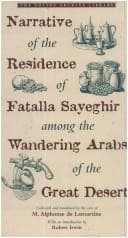
Narrative of the residence of Fatalla Sayeghir among the wandering Arabs of the great desertLamartine, Alphonse de
History
Narrative of the residence of Fatalla Sayeghir among the wandering Arabs of the great desert
Lamartine, Alphonse de
Arabian Peninsula -- Description and travel
A little after, our guides cried out, “Here’s the village!”
and we entered the first house. It belonged to a farrier, named Hanna
el Bitar. He showed a lively sympathy in our situation, set about
covering us both with camel-dung, and gave us a little wine--a few
drops at a time: having thus restored our strength and warmth, he
withdrew us from our dunghill, put us to bed, and made us take some
good soup. After a sleep, which was indispensable, we borrowed two
hundred piastres to pay our guides and carry us to Damascus, which we
reached the 23d December, 1810.
M. Chabassan, a French physician, the only Frank at Damascus, received
us; but as we were to pass the winter here, we afterwards took up our
quarters in the Lazarist Convent, which was abandoned.
I will not describe the celebrated city of Sham (Damascus), the Gate of
Glory (Bab el Cahbé), as the Turks style it. Our long residence has
enabled us to know it minutely; but it has been too often visited by
travellers to offer any new interest. I return to my narrative.
One day, being at the bazaar to pass away the time in the Turkish
fashion, we saw running towards us a Bedouin, who embraced us, saying,
“Do you not recollect your brother Hettall, who ate your bread at
Nuarat el Nahaman?” Delighted with meeting him, we took him home, and
having regaled him, and asked him many questions, we learned that the
affairs of the tribe Hassnnée were in a bad condition, and that the
league against them was extending daily. Hettall told us that he was
of the tribe of Would Ali, whose chief, Douhi, was known to us. This
tribe winters in the territory of Sarka and Balka; it reaches from
the country of Ismael to the Dead Sea, and returns to Horan in the
spring. He proposed to us to visit it, promising a good sale for our
merchandise. Having consented, it was agreed that he should come for us
in the month of March.
Sheik Ibrahim having received, through the intervention of M.
Chabassan, a group of a thousand tallaris from Aleppo, desired me to
make new purchases. When they were completed, I showed them to him,
and asked whether any thing would remain for us at our return? “My
dear son,” he replied, “the gratitude of every chief of a tribe brings
me more than all my merchandise.--Be under no concern. You also shall
receive your return in money and in reputation. You shall be renowned
in your time; but I must know all the tribes and their chiefs. I depend
upon you to get to the Drayhy, and for that purpose you must absolutely
pass for a Bedouin. Let your beard grow, dress like them, and imitate
their usages. Ask no explanations--remember our terms.” My only reply
was, “May God give us strength!”
Twenty times was I on the point of abandoning an enterprise of which
I perceived all the dangers without knowing the object. This silence,
this blind obedience, became insupportable. However, my wish to come to
the issue, and my attachment to M. Lascaris, gave me patience.
Public-domain text, read in full here on John Shaqi.
Reviews
Reviews
No reviews yet
Be the first to share your thoughts on this work.
Join the Discussion
Join the discussion
Sign in to leave a comment or review.
Sign InorCreate an account