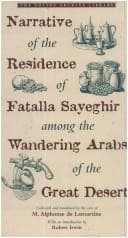
Narrative of the residence of Fatalla Sayeghir among the wandering Arabs of the great desertLamartine, Alphonse de
History
Narrative of the residence of Fatalla Sayeghir among the wandering Arabs of the great desert
Lamartine, Alphonse de
Arabian Peninsula -- Description and travel
At the time agreed, Hettall arrived with three camels and two guides,
and we set out the 15th March, 1811, one year and twenty-eight days
after our first departure from Aleppo. The tribe was at a place called
Misarib, three days from Damascus. Nothing remarkable happened on
the road. We passed the nights under a starry sky; and on the third
day, by sunset, we were in the midst of the tents of Would Ali. The
_coup d’œil_ was delightful. Every tent was surrounded by horses,
camels, goats, and sheep, with the lance of the horseman planted at
the entrance: that of the Emir Douhi arose in the centre. He received
us with all possible consideration, and made us sup with him. He is a
man of understanding, and is equally loved and feared by his people.
He commands five thousand tents, and three tribes, which are joined to
his; those of Benin Sakhrer, of El Serhaan, and El Sarddié. He had
divided his soldiers into companies or divisions, each commanded by one
of his kinsmen.
The Bedouins are fond of hearing stories after supper. This is one
that the emir told us: it depicts the extreme attachment they have for
their horses, and the self-love they manifest with regard to their own
qualities.
One of his tribe, named Giabal, possessed a very celebrated mare.
Hassad Pacha, then vizier of Damascus, made him on various occasions
all sorts of offers to part with it, but in vain, for a Bedouin loves
his horse as he does his wife. The pacha then employed threats, but
with no better success. At length, another Bedouin, named Giafar,
came to the pacha, and asked what he would give him if he brought him
Giabal’s mare? “I will fill thy barley sack with gold,” replied Hassad,
who felt indignant at his want of success. This took place without
transpiring; and Giabal fastened his mare at night by the foot with an
iron ring, the chain of which passed into his tent, being held by a
picket fixed in the ground under the very felt which served him and his
wife as a bed. At midnight, Giafar creeps into the tent on all-fours,
and, insinuating himself between Giabal and his wife, gently pushes
first the one, and then the other: the husband thought his wife was
pushing, the wife thought the same of the husband; and each made more
room. Giafar then, with a knife well sharpened, makes a slit in the
felt, takes out the picket, unties the mare, mounts her, and, grasping
Giabal’s lance, pricks him slightly with it, calling out, “It is I,
Giafar, who have taken thy noble mare; I give thee early notice!”
and off he goes. Giabal instantly darts from the tent, calls his
friends, mounts his brother’s mare, and pursues Giafar for four hours.
Giabal’s brother’s mare was of the same blood as his own, though not
so good. Outstripping all the other horsemen, he was on the point of
overtaking Giafar, when he cried out, “Pinch her right ear, and give
her the stirrup.” Giafar did so, and flew like lightning. The pursuit
was then useless: the distance between them was too great. The other
Public-domain text, read in full here on John Shaqi.
Reviews
Reviews
No reviews yet
Be the first to share your thoughts on this work.
Join the Discussion
Join the discussion
Sign in to leave a comment or review.
Sign InorCreate an account