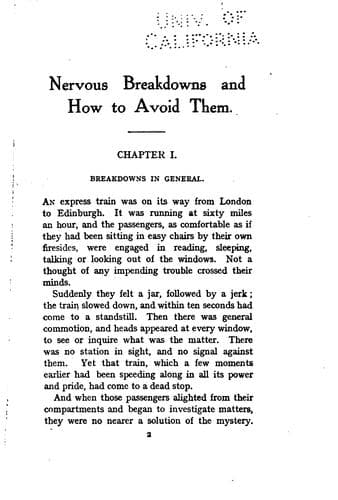
Nervous Breakdowns and How to Avoid ThemMusgrove, Charles David
Science
Nervous Breakdowns and How to Avoid Them
Musgrove, Charles David
Mental health
Influenza comes like a bolt from the blue, attacking its victims with
disconcerting suddenness. To be sure, breakdowns may appear, in many
cases at least, to come in a fell swoop; but what seems so abrupt and
unlooked for is usually the climax to a long-continued process of
undermining, like the collapse of a house, which has succumbed to the
ravages of time. Yet the events which have led up to it may have been
spread over a large number of years.
[Sidenote: The nature of a breakdown.]
Occasionally we hear of someone who has been disabled all of a sudden
by some definite form of ailment, paralysis, cancer or heart disease,
it may be. Such cases are, however, the exception, and they are not
the breakdowns with which we are now concerned. In the great majority
of instances “breaking down” is the final stage of a long process of
“running down.” There is as much difference between the two classes of
cases as between an engine which has come to a stop because a wheel has
come off or a connecting-rod broken, and one that has become useless
owing to neglect or prolonged wear and tear.
The period of running down may last for months or years, and it is
characterised by various symptoms, physical and nervous. It is the
former which are at the root of the matter, but the others predominate
more and more, until, when the final breakdown occurs, they overwhelm
the bodily symptoms altogether. On this account it is usually
designated by terms expressing this nervous element: nervous exhaustion
or debility, neurasthenia or simply nerves. Yet all these are only
different phases or stages of the same complaint.
What, then, is the nature of this complaint? It is one that has
suffered from much misapprehension, chiefly through the use of the
term “nervous exhaustion.” This phrase has given rise to an impression
in the lay mind that there is a limit to the nervous force with which
human beings are endowed, as though each one started with a certain
quantity which must come to an end sooner or later.
This idea is a fallacy, for nervous energy is in process of being
manufactured every hour we live. And Nature stores up out of this
supply a reserve from which we may draw in any emergency that may
demand a special output.
This reserve fund is constantly varying. It is replenished during the
hours of sleep, it is called upon during the period of wakefulness.
Sometimes an extra call has to be made upon it. A woman may have her
night’s rest broken, or she may even lose her sleep altogether for
several nights in succession. Or a man may have a sudden stress of work
which cannot be avoided. Then the reserve may be depleted, but that
does not constitute a breakdown. If care is taken to ensure sufficient
rest afterwards, the surplus is regained. It is only when a constant
drain is put upon it that serious damage results.
[Sidenote: The two types.]
Public-domain text, read in full here on John Shaqi.
Reviews
Reviews
No reviews yet
Be the first to share your thoughts on this work.
Join the Discussion
Join the discussion
Sign in to leave a comment or review.
Sign InorCreate an account