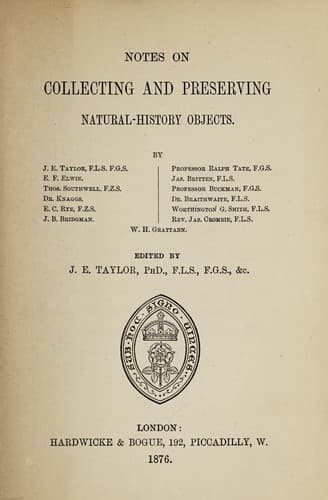
Notes on Collecting and Preserving Natural-History Objects
Science
Notes on Collecting and Preserving Natural-History Objects
Botanical specimens -- Collection and preservation; Zoological specimens -- Collection and preservation
From causes which need not be explained here, the shells living in some
ponds are all much eroded, or coated with a ferruginous deposit; it
will be desirable therefore to find out the localities where specimens
are in the best condition, so that you may have typical specimens for
comparison before an extensive collection is made.
Our experience is, that though a considerable number of species may
be obtained from a ditch or pond, yet a few are found as the sole
molluscan tenants of particular sheets of water; that lakes exhibit a
dearth of life, and that the greatest variety is often to be met with
in canals; but should a search be carried on in them, avoid the towpath
side, for reasons that a little thought will readily suggest.
Living near the sea, and within a short distance of wooded hill-sides,
we had within a limited area such a variety of physical features that
we were led to infer the existence of a rich molluscan fauna for the
neighbourhood. Our second excursion was devoted to a search for snails
along the sea margin and shores of the estuary. Proceeding along the
low sand-dunes--at first sight a most uninteresting spot--_Helix
caperata_, _H. virgata_, _Bulimus acutus_, and a few other snails, were
found clustering upon the low stunted vegetation in such numbers, that
handfuls might have been gathered within an area of a few square feet.
Leaving the seashore, our way led us over the foreshore of the mouth
of the river, crushing under our feet at every step shells of _Cardium
edule_, _Scrobicularia piperata_, and a few other bivalves which find
a congenial habitat in such situations. Gaining the muddy margins of
the higher part of the estuary, _Conovulus_ was looked for, and found
under the stones along the high-water mark. Higher up the river the
rejectamentum on its banks was carefully turned over, and we were
successful in securing a number of land shells. The animals, of course,
do not live in such places; but their empty shells, which alone were
found, had been brought down from the land surface by the agency of
the streams and tributaries of the river. Nevertheless such an _omnium
gatherum_ should demand attention, as its contents give an insight
into the character of the land and freshwater forms within the area of
drainage of the river.
Public-domain text, read in full here on John Shaqi.
Reviews
Reviews
No reviews yet
Be the first to share your thoughts on this work.
Join the Discussion
Join the discussion
Sign in to leave a comment or review.
Sign InorCreate an account