Notes on Novelists, with Some Other Notes — John Shaqi
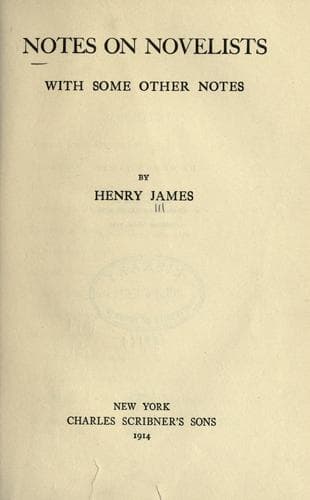
Notes on Novelists, with Some Other NotesJames, Henry
History
Notes on Novelists, with Some Other Notes
James, Henry
Fiction -- History and criticism; Novelists
It is all very well to talk of renunciation, and of course it
has to be done. But for my part, give me a roaring toothache! I
do like to be deceived and to dream, but I have very little use
for either watching or meditation. I was not born for age. . . .
I am a childless, rather bitter, very clear-eyed, blighted
youth. I have, in fact, lost the path that makes it easy and
natural for you to descend the hill. I am going at it straight.
And where I have to go down it is a precipice. . . . You can
never write another dedication that can give the same pleasure
to the vanished Tusitala.
Two days later he met his end in the happiest form, by the straight
swift bolt of the gods. It was, as all his readers know, with an
admirable unfinished thing in hand, scarce a quarter written—a
composition as to which his hopes were, presumably with much justice and
as they were by no means always, of the highest. Nothing is more
interesting than the rich way in which, in “Weir of Hermiston” and
“Catriona,” the predominant imaginative Scot reasserts himself after
gaps and lapses, distractions and deflections superficially extreme.
There are surely few backward jumps of this energy more joyous and _à
pieds joints_, or of a kind more interesting to a critic. The
imaginative vision is hungry and tender just in proportion as the actual
is otherwise beset; so that we must sigh always in vain for the quality
that this purified flame, as we call it, would have been able to give
the metal. And how many things for the critic the case suggests—how
many possible reflections cluster about it and seem to take light from
it! It was “romance” indeed, “Weir of Hermiston,” we feel, as we see it
only grow in assurance and ease when the reach to it over all the spaces
becomes more positively artificial. The case is _literary_ to intensity,
and, given the nature of the talent, only thereby the more beautiful: he
embroiders in silk and silver—in defiance of climate and nature, of
every near aspect, and with such another antique needle as was nowhere,
least of all in those latitudes, to be bought—in the intervals of
wondrous international and insular politics and of fifty material cares
and complications. His special stock of association, most personal style
and most unteachable trick fly away again to him like so many strayed
birds to nest, each with the flutter in its beak of some scrap of
document or legend, some fragment of picture or story, to be retouched,
revarnished and reframed.
Public-domain text, read in full here on John Shaqi.
Reviews
Reviews
No reviews yet
Be the first to share your thoughts on this work.
Join the Discussion
Join the discussion
Sign in to leave a comment or review.
Sign InorCreate an account