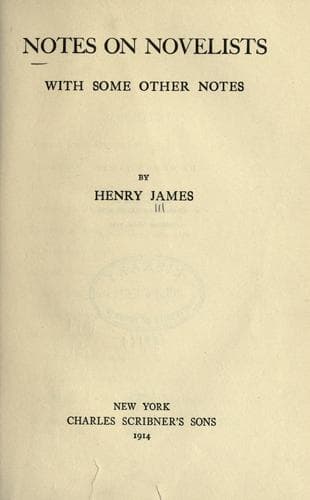
Notes on Novelists, with Some Other NotesJames, Henry
History
Notes on Novelists, with Some Other Notes
James, Henry
Fiction -- History and criticism; Novelists
These things he does with a gusto, moreover, for which it must be
granted that his literary treatment of the islands and the island life
had ever vainly waited. Curious enough that his years of the tropics and
his fraternity with the natives never drew from him any such “rendered”
view as might have been looked for in advance. For the absent and
vanished Scotland he _has_ the image—within the limits (too narrow ones
we may perhaps judge) admitted by his particular poetic; but the law of
these things in him was, as of many others, amusingly, conscientiously
perverse. The Pacific, in which he materially delighted, made him
“descriptively” serious and even rather dry; with his own country, on
the other hand, materially impossible, he was ready to tread an endless
measure. He easily sends us back again here to our vision of his
mixture. There was only one thing on earth that he loved as much as
literature—which was the total absence of it; and to the present, the
immediate, whatever it was, he always made the latter offering. Samoa
was susceptible of no “style”—none of that, above all, with which he
was most conscious of an affinity—save the demonstration of its
rightness for life; and this left the field abundantly clear for the
Border, the Great North Road and the eighteenth century. I have been
reading over “Catriona” and “Weir” with the purest pleasure with which
we can follow a man of genius—that of seeing him abound in his own
sense. In “Weir” especially, like an improvising pianist, he
superabounds and revels, and his own sense, by a happy stroke, appeared
likely never more fully and brightly to justify him; to have become even
in some degree a new sense, with new chords and possibilities. It is the
“old game,” but it is the old game that he exquisitely understands. The
figure of Hermiston is creative work of the highest order, those of the
two Kirsties, especially that of the elder, scarce less so; and we ache
for the loss of a thing which could give out such touches as the quick
joy, at finding herself in falsehood, of the enamoured girl whose
brooding elder brother has told her that as soon as she has a lover she
will begin to lie (“ ‘Will I have gotten my jo now?’ she thought with
secret rapture”); or a passage so richly charged with imagination as
that in which the young lover recalls her as he has first seen and
desired her, seated at grey of evening on an old tomb in the moorland
and unconsciously making him think, by her scrap of song, both of his
mother, who sang it and whom he has lost, and
Public-domain text, read in full here on John Shaqi.
Reviews
Reviews
No reviews yet
Be the first to share your thoughts on this work.
Join the Discussion
Join the discussion
Sign in to leave a comment or review.
Sign InorCreate an account