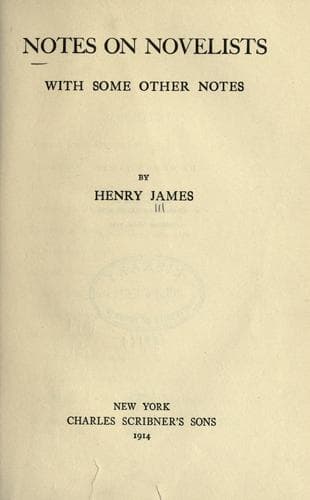
Notes on Novelists, with Some Other NotesJames, Henry
History
Notes on Novelists, with Some Other Notes
James, Henry
Fiction -- History and criticism; Novelists
There are efforts here at stout perusal that, frankly, I have been
unable to carry through, and I should verily like, in connection with
the vanity of these, to dispose on the spot of the sufficiently strange
phenomenon constituted by what I have called the climax. It embodies in
fact an immense anomaly; it casts back over Zola’s prime and his middle
years the queerest grey light of eclipse. Nothing moreover—nothing
“literary”—was ever so odd as in this matter the whole turn of the
case, the consummation so logical yet so unexpected. Writers have grown
old and withered and failed; they have grown weak and sad; they have
lost heart, lost ability, yielded in one way or another—the possible
ways being so numerous—to the cruelty of time. But the singular doom of
this genius, and which began to multiply its symptoms ten years before
his death, was to find, with life, at fifty, still rich in him, strength
only to undermine all the “authority” he had gathered. He had not grown
old and he had not grown feeble; he had only grown all too wrongly
insistent, setting himself to wreck, poetically, his so massive
identity—to wreck it in the very waters in which he had formally
arrayed his victorious fleet, (I say “poetically” on purpose to give him
the just benefit of all the beauty of his power.) The process of the
disaster, so full of the effect, though so without the intention, of
perversity, is difficult to trace in a few words; it may best be
indicated by an example or two of its action.
The example that perhaps most comes home to me is again connected with a
personal reminiscence. In the course of some talk that I had with him
during his first visit to England I happened to ask him what opportunity
to travel (if any) his immense application had ever left him, and
whether in particular he had been able to see Italy, a country from
which I had either just returned or which I was luckily—not having the
Natural History of a Family on my hands—about to revisit. “All I’ve
done, alas,” he replied, “was, the other year, in the course of a little
journey to the south, to my own _pays_—all that has been possible was
then to make a little dash as far as Genoa, a matter of only a few
days.” “Le Docteur Pascal,” the conclusion of Les Rougon-Macquart, had
appeared shortly before, and it further befell that I asked him what
plans he had for the future, now that, still _dans la force de l’âge_,
he had so cleared the ground. I shall never forget the fine promptitude
of his answer—“Oh, I shall begin at once Les Trois Villes.” “And which
cities are they to be?” The reply was finer still—“Lourdes, Paris,
Rome.”
Public-domain text, read in full here on John Shaqi.
Reviews
Reviews
No reviews yet
Be the first to share your thoughts on this work.
Join the Discussion
Join the discussion
Sign in to leave a comment or review.
Sign InorCreate an account