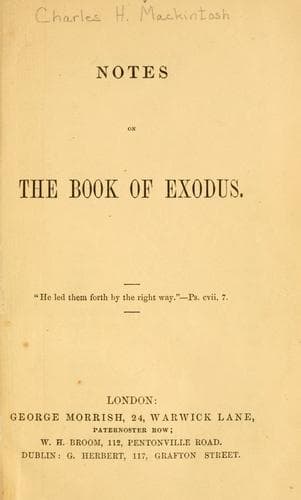
Notes on the book of ExodusMackintosh, Charles Henry
Religion
Notes on the book of Exodus
Mackintosh, Charles Henry
Bible. Exodus -- Commentaries
Let my reader ponder this deeply. We must not be satisfied with
wishing well to, doing service for, or speaking kindly on behalf of,
the people of God. We ought to be fully identified _with_ them, no
matter how despised or reproached they may be. It is, in a measure, an
agreeable thing to be a benevolent and generous spirit, to patronize
Christianity; but it is a wholly different thing to be identified with
Christians, or to suffer with Christ. A _patron_ is one thing, a
_martyr_ is quite another. This distinction is apparent throughout the
entire book of God. Obadiah took care of God's witnesses, but Elijah
was a witness for God. Darius was so attached to Daniel that he lost a
night's rest on his account, but Daniel spent that self-same night in
the lion's den, as a witness for the truth of God. Nicodemus ventured
to speak a word _for_ Christ, but a more matured discipleship would
have led him to identify himself _with_ Christ.
These considerations are eminently practical. The Lord Jesus does not
want patronage; He wants fellowship. The truth concerning Him is
declared to us, not that we might patronize His cause on earth, but
have fellowship with His Person in heaven. He identified Himself with
us, at the heavy cost of all that love could give. He might have
avoided this. He might have continued to enjoy His eternal place "in
the bosom of the Father." But how, then, could that mighty tide of
love, which was pent up in His heart, flow down to us guilty and
hell-deserving sinners? Between Him and us there could be no oneness,
save on conditions which involved the surrender of everything on His
part. But, blessed, throughout the everlasting ages, be His adorable
name, that surrender was voluntarily made. "He gave Himself for us,
that He might redeem us from all iniquity, and purify _unto Himself_ a
peculiar people, zealous of good works." (Titus ii. 14.) He would not
enjoy His glory alone. His loving heart would gratify itself by
associating "many sons" with Him in that glory. "Father," He says, "I
will that they also, whom Thou hast given Me, be _with Me_ where I am;
that they may behold My glory, which Thou hast given Me: for Thou
lovedst Me before the foundation of the world." (John xvii. 24.) Such
were the thoughts of Christ in reference to His people; and we can
easily see how much in sympathy with these precious thoughts was the
heart of Moses. He unquestionably partook largely of his Master's
spirit; and he manifested that excellent spirit in freely sacrificing
every personal consideration, and associating himself, unreservedly,
with the people of God.
Public-domain text, read in full here on John Shaqi.
Reviews
Reviews
No reviews yet
Be the first to share your thoughts on this work.
Join the Discussion
Join the discussion
Sign in to leave a comment or review.
Sign InorCreate an account