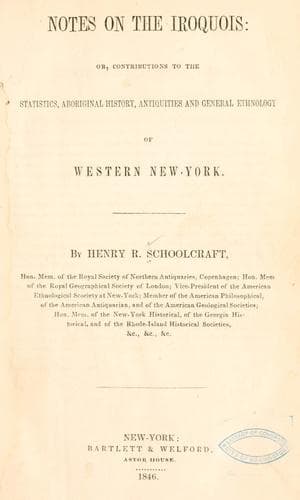
Notes on the Iroquois: or, Contributions to the Statistics, Aboriginal History, Antiquities and General Ethnology of Western New-YorkSchoolcraft, Henry Rowe
History
Notes on the Iroquois: or, Contributions to the Statistics, Aboriginal History, Antiquities and General Ethnology of Western New-York
Schoolcraft, Henry Rowe
Indians of North America -- New York (State); Iroquois Indians
The word Iroquois, as we are told by Charlevoix, who is a competent
and reliable witness on this point, is founded on an exclamation,
or response, made by the sachems and warriors, on the delivery to
them, of an address. This response, as heard among the Senecas, it
appeared to me, might be written _eoh_; perhaps, the Mohawks, and
other harsher dialects of this family, threw in an r, between the
vowels. It is recorded in the term Iroquois, on French principles
of annotation, with the substantive inflection in _ois_, which is
characteristic of French lexicography. It is a term which has been
long, and extensively used, both for the language and the history
of this people; and is preferable, on enlarged considerations, to
any other. The term Five Nations, used by Colden, and in popular use
during the earlier period of the colony, ceased to be appropriate
after the Tuscarora revolt in North Carolina, and the reunion of this
tribe with the parent stock, subsequent to 1712. From that period they
were called the Six Nations,[12] and continued to acquire increased
reputation as a confederacy, under this name, until the termination
of the American Revolution in 1783, and the flight of the Mohawks and
Cayugas to Canada, when this partial separation and breaking up of the
confederacy, rendered it no longer applicable.
[12] In 1723, they adopted the NECARIAGES, as a Seventh
Nation, as will be noticed under the appropriate head.
The term NEW-YORK INDIANS, applied to them in modern days,
by the eminence in their position, is liable to be confounded, by
the common reader, with the names of several tribes of the generic
Algonquin family, who formerly occupied the southern part of the State,
down to the Atlantic. Some of these tribes lived in the west, and owned
and occupied lands, among the Iroquois, until within a few years. And,
at any rate, it is too vague and imprecise a term to be employed in
philology or history.
By the people themselves, however, neither the first nor the last of
the foregoing terms appear ever to have been adopted, nor are they now
used. They have no word to signify “New-York” in a sense more specific,
than as the territory possessed by themselves—a claim which they were
certainly justified in making, at the era of the discovery, when they
are admitted, on all hands, to have carried their conquests to the sea.
Public-domain text, read in full here on John Shaqi.
Reviews
Reviews
No reviews yet
Be the first to share your thoughts on this work.
Join the Discussion
Join the discussion
Sign in to leave a comment or review.
Sign InorCreate an account