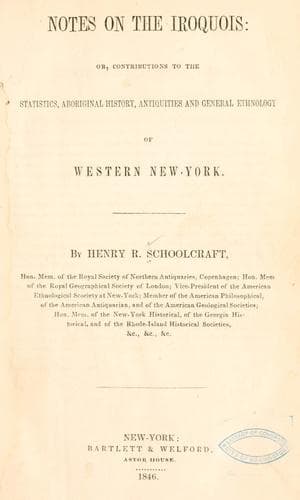
Notes on the Iroquois: or, Contributions to the Statistics, Aboriginal History, Antiquities and General Ethnology of Western New-YorkSchoolcraft, Henry Rowe
History
Notes on the Iroquois: or, Contributions to the Statistics, Aboriginal History, Antiquities and General Ethnology of Western New-York
Schoolcraft, Henry Rowe
Indians of North America -- New York (State); Iroquois Indians
The term _Ongwe Honwe_, or a people surpassing all others, which Colden
was informed they applied proudly to themselves, may be strictly true,
if limited, as they did, to mean a people surpassing all other red men.
This they believed, and this was the sense in which they boastfully
applied it. But it was a term older than the discovery, and had no
reference to European races. The word _Honwe_, as will appear by the
vocabulary hereto appended, means man. By the prefixed term _Ongwe_,
it is qualified according to various interpretations, to mean real,
as contradistinguished from sham men, or cowards; it may also mean
strong, wise, or expert men, and, by ellipsis, men excelling others in
manliness. But it was in no other sense distinctive of them. It was
the common term for the red race of this continent, which they would
appear, by the phrase, to acknowledge as a unity, and is, the word as I
found it, used at this day, as the equivalent for our term “Indian.”
Each tribe had, at some period of their progress, a distinctive
appellation, as Onondaga, Oneida, &c. of which some traditionary matter
will be stated, further on. When they came to confederate, and form
a general council, they took the name of KONOSHIONI, (or as
the French authors write it, _Acquinoshioni_), meaning literally,
People of the Long House, and figuratively a UNITED PEOPLE,
a term by which they still denominate themselves, when speaking in a
national sense. This distinction, it is well to bear in mind, and not
confound. This Long House, to employ their own figure, extended east
and west from the present site of Albany to the foot of the great
lakes, a distance, by modern admeasurement, of 325 miles, which is now
traversed by railroad. An air palace, we may grant them, having beams
and rafters, higher and longer than any pile of regal magnificence, yet
reared by human hands.
Public-domain text, read in full here on John Shaqi.
Reviews
Reviews
No reviews yet
Be the first to share your thoughts on this work.
Join the Discussion
Join the discussion
Sign in to leave a comment or review.
Sign InorCreate an account