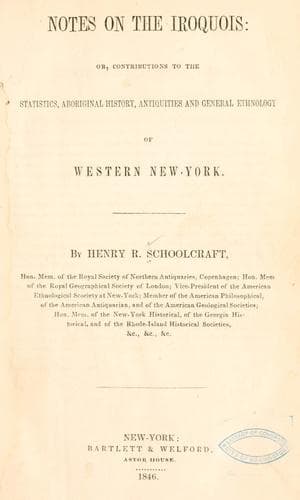
Notes on the Iroquois: or, Contributions to the Statistics, Aboriginal History, Antiquities and General Ethnology of Western New-YorkSchoolcraft, Henry Rowe
History
Notes on the Iroquois: or, Contributions to the Statistics, Aboriginal History, Antiquities and General Ethnology of Western New-York
Schoolcraft, Henry Rowe
Indians of North America -- New York (State); Iroquois Indians
Thus much may be said, with certainty, of the name of this celebrated
family of red men, by which they are identified and distinguished
from other stocks of the hunter tribes of North America. Where they
originated, relatively to their position on this continent, the
progress of ethnology does not, at this incipient period of that
science, enable us to determine, nor is it proposed, save with the
merest brevity, now to inquire. Veiling their own origin, if anciently
known, in allegory, or designing by fancy to supply the utter want
of early history, to the intent, perhaps, that they might put forth
an undisputed title to the country they occupied, the relations
of their old sages affirm that they originated in the territorial
area of western New-York. Their tradition on this point, as put on
record by the pen of one of their own people, (see extracts from
Cusic’s historical and traditionary tract, hereto appended,) fixes
the locality of their actual origin at an eminence near the falls
of the Oswego river. To cut short the narration, they assert that
their ancestors were called forth, from the bowels of a mountain, by
TARENYAWAGON, the Holder of the Heavens. It represents them
as one people, who moved first towards the east, as far as the sea,
and then fell back, partly on their own tracks, towards the west and
southwest. So far, and so far only, the tale appears credible enough,
and as there is no chronology established by it, although dates are
freely introduced, and consequently nothing to contradict it, their
track of migration and countermigration from the Oswego, may be deemed
as probable.
The diversities of language, and the separation into tribes, are
represented to have taken place, according to known principles of
ethnological inference.
Ondiyaka, an Onondaga sage, and the ruling chief of the confederacy,
who died on an official visit to the Oneidas in 1839, at the age of
ninety, confirmed these general traditions of the Tuscarora scribe. He
informed Le Fort, who was with him in that journey and at his death,
that the Onondagas were created by NEO,[13] in the country
where they lived; that he made this island or continent, “Hawoneo,”
for the red race, and meant it for them alone. He did not allude to
or acknowledge any migration from other lands. This, Le Fort, himself
an Onondaga, a chief, and an educated man, told me during the several
interviews I had with him, the present year, at the Onondaga Castle.
[13] The term “Neo,” God, is generally used reverently, with a syllable
prefixed in the different Iroquois dialects, as Yawa-Neo, in the
Tuscarora, Howai-Neo in the Seneca, Hawai-Neo, Onondaga, Lawai-Neo,
Mohawk, &c.
Public-domain text, read in full here on John Shaqi.
Reviews
Reviews
No reviews yet
Be the first to share your thoughts on this work.
Join the Discussion
Join the discussion
Sign in to leave a comment or review.
Sign InorCreate an account