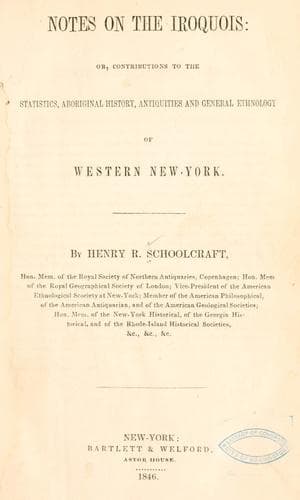
Notes on the Iroquois: or, Contributions to the Statistics, Aboriginal History, Antiquities and General Ethnology of Western New-YorkSchoolcraft, Henry Rowe
History
Notes on the Iroquois: or, Contributions to the Statistics, Aboriginal History, Antiquities and General Ethnology of Western New-York
Schoolcraft, Henry Rowe
Indians of North America -- New York (State); Iroquois Indians
Ask not the red sage to tell you how? or when? or where? He knows it
not, and if he should pretend to the knowledge, it would be the surest
possible evidence, philosophically considered, that his responses
were fabulous. Three hundred and fifty-three years only has America
been known to Europe, and yet should we strike our history out of
existence, what should we know of the leading facts of the discovery
and the discoverer from Indian tradition? Still the inquisitive spirit
of research leads us to ask, where were this race eighteen hundred and
forty-five years ago? or at the invasion of Britain by Julius Cæsar?
or at the outpouring of the Gothic hordes under Alaric or Brennus?
Scandinavian research tells us they were here in the 10th century.
The Mexican picture writings inform us that some of them reached the
valley of Mexico in the 11th century. Welsh history claims to have
sent one of her princes among them in the 12th century. The mounds
of the Mississippi valley do not appear to have had an origin much
earlier. The whole range of even historical conjecture is absolutely
limited within eight or nine hundred years. Nothing older, of their
presence here certainly, is known, than about the time of the crowning
of Charlemagne, A. D. 800, unless we take the Grecian tradition of
Atlantis.
That we have nothing in the way of tradition older than the dates
referred to, is no positive proof that the tribes were not upon the
continent long prior. There are some considerations, in the very
nature of the case, which argue a remote continental antiquity for
these tribes. It is hardly to be supposed that large numbers of the
primitive adventurers landed at any one time or place; nor is it more
probable that the epochs of these early adventurers were very numerous.
The absolute conformity of physical features renders this improbable.
The early migrations must have been necessarily confined to portions
of the old world peopled by the RED RACE—by a race, not only of red
skins, black hair and eyes, and high cheek bones, who would reproduce
these fixed characteristics, _ad infinitum_, but whose whole mental as
well as physiological development assimilates it, as a distinct unity
of the species. While physiology, however, asserts this unity, in the
course of the dispersion and multiplication of tribes, their languages,
granting all that can be asked for on the score of original diversity,
became divided into an infinite number of dialects and tongues. Between
these dialects, however, where they are even the most diverse, there
is a singular coincidence in many of the leading principles of concord
and regimen, and polysynthetic arrangement. Such diversities in sound,
amounting, as they do in many cases, for instance, in the stocks of
the Algonquin and Iroquois, to an almost total difference, must have
required many ages for their production. And this fact alone affords a
proof of the continental antiquity of the American race.
[_c._] Indian Cosmogony.
Public-domain text, read in full here on John Shaqi.
Reviews
Reviews
No reviews yet
Be the first to share your thoughts on this work.
Join the Discussion
Join the discussion
Sign in to leave a comment or review.
Sign InorCreate an account