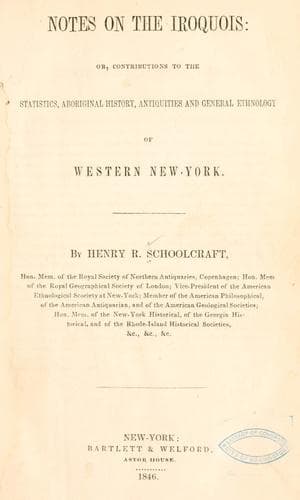
Notes on the Iroquois: or, Contributions to the Statistics, Aboriginal History, Antiquities and General Ethnology of Western New-YorkSchoolcraft, Henry Rowe
History
Notes on the Iroquois: or, Contributions to the Statistics, Aboriginal History, Antiquities and General Ethnology of Western New-York
Schoolcraft, Henry Rowe
Indians of North America -- New York (State); Iroquois Indians
ORIGIN OF THE CONTINENT, OF THE ANIMAL CREATION, AND OF THE
INDIAN RACE: THE INTRODUCTION OF THE TWO PRINCIPLES OF GOOD AND
EVIL INTO THE GOVERNMENT OF THE WORLD.
Iroquois tradition opens with the notion that there were originally
two worlds, or regions of space, namely, an upper and lower world.
The upper was inhabited by beings similar to the human race; the
lower by monsters, moving in the waters. When the human species were
transferred below, and the lower sphere was about to be rendered fit
for their residence, the act of their transference or reproduction is
concentrated in the idea of a female, who began to descend into the
lower world, which is depicted as a region of darkness, waters and
monsters. She was received on the back of a tortoise, where she gave
birth to male twins, and expired. The shell of this tortoise expanded
into the continent, which, in their phraseology, is called an “island;”
and is named by the Onondagas, AONAO. One of the infants was called
INIGORIO, or the Good Mind; the other, INIGOHATEA,
or the Bad Mind. These two antagonistical principles, which are such
perfect counterparts of the Ormuzd and Ahriman of the Zoroaster, were
at perpetual variance, it being the law of one to counteract whatever
the other did. They were not, however, men, but gods, or existences,
through whom the “Great Spirit,” or “Holder of the Heavens,” carried
out his purposes. The first labor of Inigorio was to create the sun
out of the head of his dead mother, and the moon and the stars out of
other parts of the body. The light these gave, drove the monsters into
deep water, to hide themselves. He then prepared the surface of the
continent, and fitted it for human habitation, by diversifying it with
creeks, rivers, lakes and plains, and by filling these with the various
species of the animal and vegetable kingdoms. He then formed a man and
woman out of earth, gave them life, and called them “Ea-gwe-ho-we,” or,
as it is more generally known to Indian archæologists, Ong-we-Hon-we;
that is to say, a real people. [D.]
Meanwhile the Bad Mind created mountains, waterfalls, and steeps and
morasses, reptiles, serpents, apes, and other objects supposed to
be injurious to, or in mockery of mankind. He made attempts also to
conceal the land animals in the ground, so as to deprive man of the
means of subsistence. This continued opposition to the wishes of the
Good Mind, who was perpetually busied in restoring the effects of
the displacements and wicked devices of the other, at length led to
a personal combat, of which the time and instruments of battle were
agreed on. They fought for two days, the one using deer’s horns, and
the other flag roots, as arms.[18] Inigorio, who had chosen horns,
finally prevailed; his antagonist sunk down to a region of darkness,
and became the Evil Spirit, or Kluneolux,[19] of the world of despair.
Inigorio, having obtained this triumph, retired from the earth.
Public-domain text, read in full here on John Shaqi.
Reviews
Reviews
No reviews yet
Be the first to share your thoughts on this work.
Join the Discussion
Join the discussion
Sign in to leave a comment or review.
Sign InorCreate an account