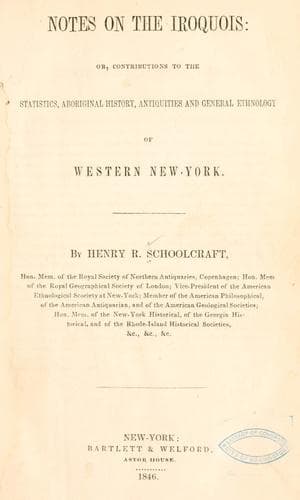
Notes on the Iroquois: or, Contributions to the Statistics, Aboriginal History, Antiquities and General Ethnology of Western New-YorkSchoolcraft, Henry Rowe
History
Notes on the Iroquois: or, Contributions to the Statistics, Aboriginal History, Antiquities and General Ethnology of Western New-York
Schoolcraft, Henry Rowe
Indians of North America -- New York (State); Iroquois Indians
They deny, as do all the tribes, a foreign origin. They assert, that
America, or AONAO, was the place of their origin. They begin by laying
down the theory, that they were the peculiar care of the Supernal Power
who created all things, and who, as a proof of his care and benevolence
of a race whom he had marked by a distinct color, created the continent
for their especial use, and placed them upon it. None of the tribes
pretend to establish dates, nor have they any astronomical data, to
fix them. But they all give to the story of their origin, or creation,
a locality, which is generally fixed to some prominent geographical
feature near to their present respective place of abode, or at least, a
spot well known. This spot, among the Iroquois cantons, is located in
the northern hemisphere.
The term, Ongwe Honwe, is used by these tribes, very much in the
manner in which the ancient Teutons called themselves, Allamanna, or
Ghermanna, from which we have the modern terms, Allemand and German. If
they did not literally call themselves “all-men,” as did these proud
tribes, they implied as much, in a term which is interpreted to mean,
real men, or a people surpassing all others. It is the common term for
the red race, as contradistinguished from all other races, and the true
equivalent of the phrase, “Indian.”
By their earliest traditions, we are told that a body of the Ongwe
Honwe, encamped on the banks of the St. Lawrence, where they were
invaded by a nation few in number, but of giant stature, called
Ronongweca.[21] After a war, brought on by personal encounters
and incidents, and carried on with perfidy and cruelty, they were
delivered at length, by the skill and courage of Yatontea,[21] who,
after retreating before them, raised a large body of men and defeated
them, after which they were supposed to be extinct. They next suffered
from the malice, perfidy, and lust of an extraordinary person called
Shotrowea,[21] who was finally driven across the St. Lawrence, and came
to a town south of the shores of lake Ontario, where, however, he only
disguised his intentions, to repeat his cruel and perfidious deeds.
This person, who assassinated many persons, and violated six virgins,
they point to as a fiend in human shape.
[21] I abbreviate these words from the originals, for the sole purpose
of making them readable to the ordinary reader.
At this time the Big Quisquis[22] invaded the country, who pushed
down the houses of the people, and created great consternation and
disturbance. After making ineffectual resistance, they fled, but were
at length relieved by a brave chief, who raised a body of men to battle
him, but the animal himself retired. In this age of monsters, their
country was invaded by another monster called the “Big Elk,” who was
furious against men,[23] and destroyed the lives of many persons, but
he was at length killed after a severe contest.
[22] Kwis Kwis is the name of a hog in modern Iroquois.
Public-domain text, read in full here on John Shaqi.
Reviews
Reviews
No reviews yet
Be the first to share your thoughts on this work.
Join the Discussion
Join the discussion
Sign in to leave a comment or review.
Sign InorCreate an account