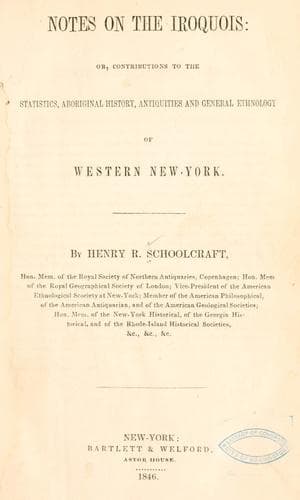
Notes on the Iroquois: or, Contributions to the Statistics, Aboriginal History, Antiquities and General Ethnology of Western New-YorkSchoolcraft, Henry Rowe
History
Notes on the Iroquois: or, Contributions to the Statistics, Aboriginal History, Antiquities and General Ethnology of Western New-York
Schoolcraft, Henry Rowe
Indians of North America -- New York (State); Iroquois Indians
[23] Carnivorous—but this is not a characteristic of the Elk.
A great horned serpent next appeared on Lake Ontario, who, by means of
his poisonous breath, produced diseases, and caused the death of many,
but he was at last compelled to retire by thunderbolts. This fourth
calamity was not forgotten, when a fifth happened. A blazing star fell
into a fort situated on the banks of the St. Lawrence, and destroyed
the people. Such a phenomenon caused great panic and dread, and they
regarded it as ominous of their entire destruction. Prior to this, a
confederation had taken place among these northern tribes, situated
north of and along the banks of the great lakes, and they had a ruling
chief over all. This ruler repaired to the south to visit a ruler of
great fame and authority, who resided at a great town in A LODGE
OF GOLD. But it only proved to be an embassy of folly, for this
great ruler, exercising an imperial sway, availing himself of the
information thus derived, of a great country full of resources, built
many forts throughout the country, and almost penetrated to the banks
of Lake Erie. The people who had confederated on the North resisted. A
long war of a hundred years standing ensued, but the northern people
were better skilled in the use of the bow and arrow, and were more
expert woodsmen and warriors. They at length prevailed, and taking all
these towns and forts, left them a heap of ruins.
But the prediction of the blazing star was now verified. The tribes
who were held together by feeble bands, fell into disputes, and wars
among themselves, which were pursued through a long period, until they
utterly destroyed each other, and so reduced their numbers, that the
land was again overrun by wild beasts. [D.]
II. ORIGIN AND HISTORY OF THE IROQUOIS, AS A DISTINCT PEOPLE.
The first period of Indian history having thus terminated in discords,
wars, and the mutual destruction of each other, tradition does not
denote how long the depopulation of the country continued. It begins
a second period by recollections of the Konoshioni, or Iroquois.
They do not indicate what relation they bear to the ancient, broken
down confederacy glanced at, in the preceding paper; but leave us to
suppose that they may have been fragmentary descendants of it. That
such a conclusion should not be formed, however, and in order to prove
themselves an original people in the land, they frame a new myth, to
begin their national existence. They boldly assert, that they were,
through some means, confined in a mountain, from whose subterraneous
bowels they were extricated by Taryenyawagon, the Holder of the
Heavens. They point to a place at or near the falls of the Oswego
river, where this deliverance happened, and they look to this divine
messenger, who could assume various shapes, as the friend and patron of
their nation.[24]
Public-domain text, read in full here on John Shaqi.
Reviews
Reviews
No reviews yet
Be the first to share your thoughts on this work.
Join the Discussion
Join the discussion
Sign in to leave a comment or review.
Sign InorCreate an account