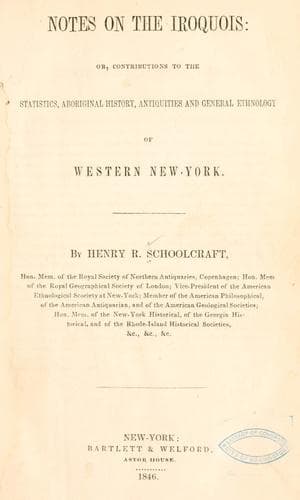
Notes on the Iroquois: or, Contributions to the Statistics, Aboriginal History, Antiquities and General Ethnology of Western New-YorkSchoolcraft, Henry Rowe
History
Notes on the Iroquois: or, Contributions to the Statistics, Aboriginal History, Antiquities and General Ethnology of Western New-York
Schoolcraft, Henry Rowe
Indians of North America -- New York (State); Iroquois Indians
[24] Where the Indians dwelt for a long time, it is customary for them
to affirm in their metaphorical language, that they originated, or
were created. When they date from such a spot, we find they frame a
story, saying that they came out of a hill, &c. at that spot. In 1791,
an extensive work, consisting of ditches, &c. was found about 40 miles
south of Oswego, which is not remote from the probable place of origin
their traditions refer to; and it may be worthy of examination with
this particular view. Some account of this old fort appeared in the N.
Y. Mag. 1792.
As soon as they were released, he gave them instructions respecting the
mode of hunting, matrimony, worship, and other points. He warned them
against the Evil Spirit, and gave them corn, beans, squashes, potatoes
and tobacco, and dogs to hunt their game. He bid them go towards the
east, and personally guided them, until they entered a valley called
Tenonanatchi, or the Mohawk. They followed this stream to its entrance
into the Sanatatea, or, as called by the Mohawks, Kohatatea, which they
pursued to the sea.
From this point they retraced their steps towards the west, originating
as they went, in their order and position, the Mohawks, the Oneidas,
the Onondagas, the Cayugas, and the Senecas. They do not omit the
Tuscaroras, whom they acknowledged, after a long period of wandering
and a considerable change of language, and admitted as the Sixth tribe
of the confederacy.
The Tuscaroras affirm, that, after reaching the lake waters, they
turned southwest, to the Mississippi river, where a part of them
crossed on a grape vine, but it broke, leaving the remainder east.
Those who went west, have been lost and forgotten from their memory.
The remainder, or eastern Tuscaroras, continued their wanderings,
hunting, and wars, until they had crossed the Alleghanies and reached
the sea again, at the mouth of the Cautoh, or Neuse river, in North
Carolina.
Public-domain text, read in full here on John Shaqi.
Reviews
Reviews
No reviews yet
Be the first to share your thoughts on this work.
Join the Discussion
Join the discussion
Sign in to leave a comment or review.
Sign InorCreate an account