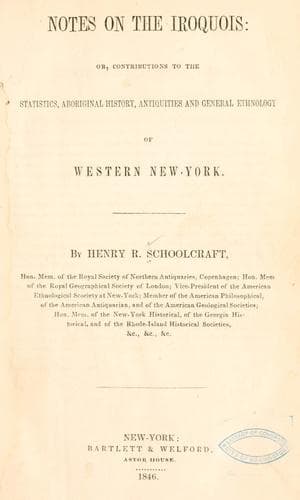
Notes on the Iroquois: or, Contributions to the Statistics, Aboriginal History, Antiquities and General Ethnology of Western New-YorkSchoolcraft, Henry Rowe
History
Notes on the Iroquois: or, Contributions to the Statistics, Aboriginal History, Antiquities and General Ethnology of Western New-York
Schoolcraft, Henry Rowe
Indians of North America -- New York (State); Iroquois Indians
Each tribe was independent of the others. They increased in numbers,
valor and skill, and in all sorts of knowledge necessary in the forest.
But they began to fight and quarrel among themselves, and thus wasted
and destroyed each other. They lived a life of perpetual fear and built
forts to defend themselves, or to protect their women and children.
Besides this, the country was wide and covered with large forests and
lakes, and it gave shelter to many fierce wild animals and monsters,
who beset their paths and kept them in dread. The evil spirit also
plagued them with monstrous visitations. They were often induced to
change their villages, sometimes from the fear of such enemies, and
sometimes from sickness or bad luck. In this manner, and owing to their
perpetual hostility, their population was often reduced. How long they
wandered and warred, they do not know. At length it was proposed by
some wise man that they should no longer fight against each other,
but unite their strength against their enemies, the Alleghans, the
Adirondacks, the Eries, and other ancient and once powerful tribes, who
figure in the foreground of their early history, and who, if accounts
be true, once greatly excelled them both in war and arts, the skill of
making implements, canoes and utensils, &c.
To this league, which was formed on the banks of Onondaga lake, they in
time, gave the name of the Long House, using the term symbolically, to
denote that they were tied and braced together by blood and lineage,
as well as political bonds. This house, agreeably to the allusion so
often made by their speakers, during our colonial history, reached from
the banks of the Hudson to the Lakes. At its eastern door stood the
Mohawks, at the west the Senecas, who guarded it with vigilance.
[_a._] The Mohawks.
The Mohawks are supposed to be the eldest brother, in the symbolical
chain of the Six Nations. Their own tradition assigns them this rank,
and it appears to be consonant to other traditions.
When Tarenyawagon, their liberator from their subterranean confinement,
bid them travel east, he gave them his personal conduct and care until
they had entered the Mohawk valley. Some of their western brethren
call this stream Tenonanatche, or a river flowing through a mountain.
In due time, they went on into the valley of the Hudson, and thence,
if we credit their annals, to the sea. The seat of their power and
growth was, however, in the genial valley where they had at first
located. Here they lived when the country was discovered, and here
they continued to live and flourish until the events of the American
revolution, and the determined cruelty which they exercised, under the
authority and influence of the British crown, drove them out of it, and
lost them the inheritance.
Public-domain text, read in full here on John Shaqi.
Reviews
Reviews
No reviews yet
Be the first to share your thoughts on this work.
Join the Discussion
Join the discussion
Sign in to leave a comment or review.
Sign InorCreate an account