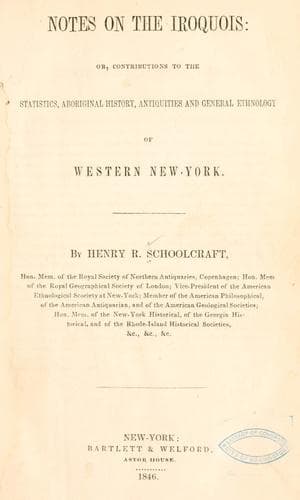
Notes on the Iroquois: or, Contributions to the Statistics, Aboriginal History, Antiquities and General Ethnology of Western New-YorkSchoolcraft, Henry Rowe
History
Notes on the Iroquois: or, Contributions to the Statistics, Aboriginal History, Antiquities and General Ethnology of Western New-York
Schoolcraft, Henry Rowe
Indians of North America -- New York (State); Iroquois Indians
The two traditions may indeed be reconciled to truth, by supposing the
latter the more ancient one, and that the Onondaga families before
mentioned, constituted a subsequent accession to, and union with a
band who had seated themselves at a prior era, at the spot denoted;
or this band may have remained there, on the general passage of the
people eastward, and thus been the nucleus of the tribe, on the general
return of the people west. In any view, however, they were called and
are still called by the Iroquois, “Younger Brother,” which must be
considered conclusive, that their nationality is of a period subsequent
to that of the Mohawks, Onondagas, Cayugas, and Senecas. This fact
too, is adverse to the theory, which has too much the aspect of a
mere theory, that the re-migration of the Iroquois westward from the
Atlantic, proceeded like a marching army, leaving tribes here and there
as they went, in a regular chronological order, each of which took a
name, and “altered,” as his phrase is, the language. The writer seems
all along, to have had the Jewish Tribes in his mind. The truth is,
ethnologically speaking, no tribe or nation, alters by an authoritative
decision, or pre-thought, its language or idioms. Such alterations
flow from time and circumstances. Least of all, do wandering savage
tribes gravely determine to “alter” their dialects. Accident, usage, or
caprice, little by little, and at long intervals, is the parent of new
dialects and languages.
A few deductions may be added. By data before introduced, it will have
been seen that it is probable the present confederation, whatever had
preceded it, did not take place till about 1539, or seventy years
before the arrival of Hudson. It may be considered as probable, that
the Oneidas did not remove from the Oneida stone, into the valley
and plains of Oneida Castle, until after the event of the final
confederation between the Five Tribes, gave them security against
internal enemies. The date of this transfer of the council fire, is
rather remote, but not very ancient. A new forest has grown upon the
old cornfields which were once cultivated at their ancient settlement
at the Oneida stone. The appearance of corn hills in rows, is still
clearly perceptible in some parts of this forest. To an inquiry how
such a preservation of the outlines of corn hills could be possible,
my informant, who was an Oneida, answered, that in ancient times,
the corn hills were made so large, that three clusters of stalks or
sub-hills were raised on each circle or hill. There being no ploughs
or other general means of turning up the earth, the same hill was used
year after year, and thus its outlines became large and well defined.
In a black walnut tree, standing on the site of one of these ancient
corn-fields, which was partly cut, and partly broken off, I counted on
the cut part, one hundred cortical layers, and measuring the broken
part, estimated it to have 140 more. Allowing a year for each ring, the
Public-domain text, read in full here on John Shaqi.
Reviews
Reviews
No reviews yet
Be the first to share your thoughts on this work.
Join the Discussion
Join the discussion
Sign in to leave a comment or review.
Sign InorCreate an account