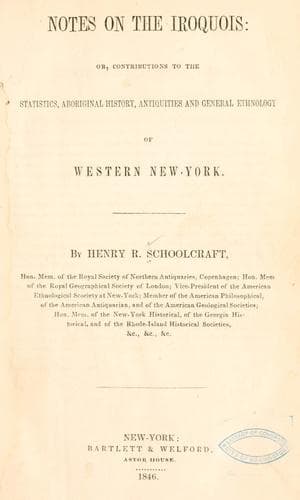
Notes on the Iroquois: or, Contributions to the Statistics, Aboriginal History, Antiquities and General Ethnology of Western New-YorkSchoolcraft, Henry Rowe
History
Notes on the Iroquois: or, Contributions to the Statistics, Aboriginal History, Antiquities and General Ethnology of Western New-York
Schoolcraft, Henry Rowe
Indians of North America -- New York (State); Iroquois Indians
commencement of the growth was in 1555, or 16 years after the supposed
date of the confederacy, and 290 years from the present date.
The remaining history of the Oneidas can only be glanced at, but has
some points of peculiar interest. They are the only tribe of the
ancient Konoshioni who adhered to us, at least the better part of
them, in our life and death struggle of the revolutionary war, saving
some portion of the Tuscaroras; whose aid, however, is justly due
to the Oneida influence. It was by the Oneidas that the Tuscaroras
were brought off from the south. The Oneidas had long distinguished
themselves in their war excursions against the southern Indians. Their
traditions are replete with accounts of these war parties against
the Oyada, or Cherokees. They had found allies at the south in the
Tuscaroras, who were themselves engaged in desperate wars, at various
periods, against the Catabas, and Cherokees, and others. Besides this,
Iroquois tradition claims the Tuscaroras as one of their original
cantons, or rather as a band of the original Eagwe Heowe, who had,
in early times gone south.[32] And when a crisis happened in their
affairs, they nobly went to their relief, and seated them on their
western confines, between themselves and the Onondagas, where they
remained during the revolution. The Oneidas bore their full share in
the long and bloody wars waged by Iroquois for more than two centuries,
against the French in the Canadas, and against the distant Algonquins,
Hurons and Illinese. And he who scans the ancient records of treaties
and councils, will find that their sachems were represented in the
conferences assembled on this continent, by the kings and potentates of
Europe, who planted colonies at various times, between the respective
Gulphs of Mexico and the St. Lawrence. After the flight of the Mohawks,
in 1776, they were in the van of the Konoshioni, and to use their
symbolic phraseology, stood in the eastern door of the Long House. When
the mixed Saxon population of New-York and New-England began, after the
war of 1776, to move westward, the Oneidas first felt the pressure upon
their territory. By siding with the colonists, they had secured their
entire ancient domain, from which they ceded to the State, from time
to time, such portions as they did not want for cultivation, taking in
lieu money annuities. Nor did they fail to profit, in a measure, by
the example of industry set before them in agriculture and the arts.
For a while, it is true, they reeled before the march of intemperance,
and sunk in numbers, but many of them learned the art of holding the
plough. From the earliest times they were noted, along with their
more western brethren, for the cultivation of Indian corn, and the
planting of orchards. They also became tolerable herdsmen, and raised
in considerable numbers, neat cattle, horses and hogs.
[32] Vide Cusick’s pamphlet.
Public-domain text, read in full here on John Shaqi.
Reviews
Reviews
No reviews yet
Be the first to share your thoughts on this work.
Join the Discussion
Join the discussion
Sign in to leave a comment or review.
Sign InorCreate an account