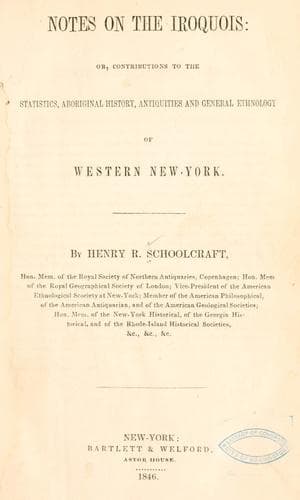
Notes on the Iroquois: or, Contributions to the Statistics, Aboriginal History, Antiquities and General Ethnology of Western New-YorkSchoolcraft, Henry Rowe
History
Notes on the Iroquois: or, Contributions to the Statistics, Aboriginal History, Antiquities and General Ethnology of Western New-York
Schoolcraft, Henry Rowe
Indians of North America -- New York (State); Iroquois Indians
Hoeyanehqui, or Sky-carrier, a Buffalo chief, in answer to a question
as to their views of the abstract right of the State to tax the tribes,
evaded a direct issue, but assuming the ground of policy, compared the
Iroquois to a sick man, and said, “that he did not believe the State
would oppress one thus weak.”
Kaweaka, a Tuscarora chief of intelligence, speaking the English
language very well, in which he is called William Mount-Pleasant, gave
a proof, in yielding to the measure promptly, that he had not failed
to profit by the use of letters. “We know our own rights. Should the
Legislature attempt to tax us, our protection is in the Constitution
of the United States, which forbids it.” This is the first appeal, it
is thought, ever made by an Iroquois to this instrument. The clause
referred to, relates however, wholly to representation in Congress,
[Vide Art. 1, Sec. II, 2d.] from the privileges of which it excludes
“Indians not taxed,” clearly implying that such persons might be
represented in that body if “taxed.” Civilization and taxation appear
to be inseparable.
III. Having detailed the steps taken in procuring the census, it only
remains to subjoin a few remarks, which I beg leave to add, on the
general features of the statistics and the results of their agriculture
upon their condition and prospects.
The printed queries being prepared exclusively for a population in a
high state of prosperity and progress, embrace many items for which
there was no occasion, among pseudo hunters, herdsmen, or incipient
agriculturists. Neither privileged to vote, nor subject to taxation,
nor military service, or covered by the common school system, or
bearing any of the characteristic tests of citizenship, the questions
designed to bring out this class of facts remained mere blanks. Others
required to institute comparisons between a civilized and quasi
savage state, were left by the tenor of your instructions, to my own
discretion. I should have been, I am free to confess, happy to have
extended these comparative views, much more fully than I have, going
further into their vital statistics, their succedaneous modes of
employment and subsistence, some parts of their lexicography, besides
that affecting the names of places, and a few kindred topics, had not
the Legislature omitted to make provision for the expenses incidental
to such extended labors, and the department to which I applied giving
me little encouragement that the oversight would be remedied. I have,
however, proceeded to render the comparative tables effectual, and,
I trust, satisfactory, and to this end, I have assumed obligations
of a very limited pecuniary character, and incurred others for travel
and some few kindred objects, which I trust the Legislature, with whom
alone the subject rests, will meet.
Public-domain text, read in full here on John Shaqi.
Reviews
Reviews
No reviews yet
Be the first to share your thoughts on this work.
Join the Discussion
Join the discussion
Sign in to leave a comment or review.
Sign InorCreate an account