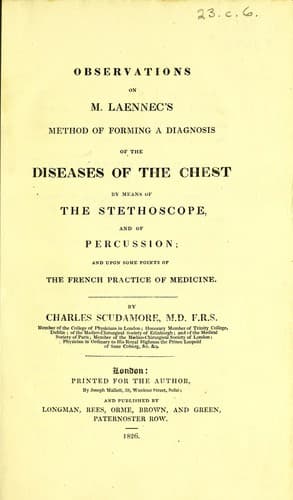
Observations on M. Laennec's method of forming a diagnosis of the diseases of the chest by means of the stethoscope, and of percussion; and upon some points of the French practice of medicine — John Shaqi
Observations on M. Laennec's method of forming a diagnosis of the diseases of the chest by means of the stethoscope, and of percussion; and upon some points of the French practice of medicineScudamore, Charles
Science
Observations on M. Laennec's method of forming a diagnosis of the diseases of the chest by means of the stethoscope, and of percussion; and upon some points of the French practice of medicine
Scudamore, Charles
Chest -- Diseases -- Diagnosis; Laennec, R. T. H. (René Théophile Hyacinthe), 1781-1826
A female patient was in a state of most alarming difficulty of
breathing from neglected inflammation of the bronchiæ, which had
extended to the lungs. The pulse was sharp and frequent, the skin
hot, and every urgent symptom of high fever and irritation was
present. Her cough was extremely violent, and the expectoration
difficult. The expectorated matter was dense and almost puriform in
appearance. On applying the stethoscope over the upper part of the
right side of the chest, at every point, and also over the whole
of the right shoulder blade, I heard acute sounds similar to those
produced by air strongly passing through a key-hole. I considered
that these sounds indicated active inflammation in the whole
ramifications of the bronchiæ of the right lung. A large quantity
of blood was drawn from the right arm; and cupping was also freely
employed, both on the chest and shoulder blade. A saline draught with
tartar emetic and nitre was administered every two hours. I need not
detail the exact progress of the case. These principles of treatment
being diligently followed up, the patient finally recovered.
A gentleman, subject to gout, took cold in the month of January from
exposure to wet. He nursed himself, but not aware of the seriousness
of his attack, had neglected to procure medical advice. I found
him affected with advanced symptoms of inflammation of the lungs;
and, without delay, directed a copious bleeding from the arm. There
was very great irritation in the stomach and bowels, attended with
painful diarrhœa; on which account, twenty leeches were applied to
the middle of the abdomen. His cough was sharp and violent. The
appearance of the blood indicated high inflammatory action, being
cupped so as to form almost a round ball. The surface of the blood
was covered with a thick buffy (fibrinous) coat, and the serum was
very abundant, being pressed, and, as it were, squeezed out from
the coagulum in the firmness of its contraction. The indication by
the stethoscope on the left side, was that of the “râle crépitante,”
or the rattle, which is compared to the crackling sound of salt when
thrown upon hot iron, and serving to shew that inflammation was
existing in the texture composing the air cells. Similar indications
were presented on the right side, but in a slighter degree. The
patient did not complain of pain in any part of the chest, but
suffered severely from oppression, having the feeling that “the room
was too small to breathe in.”
By means of repeated bleedings, blistering, and the use of suitable
medicines, the urgent symptoms were removed, and the patient in a
short time enjoyed the first feelings of convalescence. The weather
suddenly became intensely severe, and, probably from an injudicious
change of apartment, a relapse of the symptoms of violent cough,
difficulty of breathing, fever and general irritation, immediately
took place.
Public-domain text, read in full here on John Shaqi.
Reviews
Reviews
No reviews yet
Be the first to share your thoughts on this work.
Join the Discussion
Join the discussion
Sign in to leave a comment or review.
Sign InorCreate an account