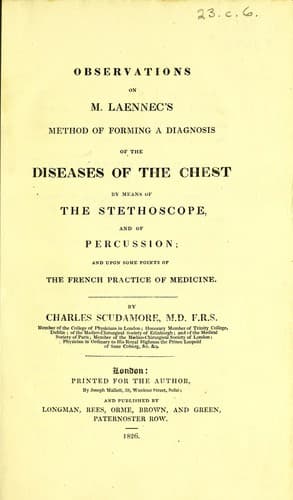
Observations on M. Laennec's method of forming a diagnosis of the diseases of the chest by means of the stethoscope, and of percussion; and upon some points of the French practice of medicineScudamore, Charles
Science
Observations on M. Laennec's method of forming a diagnosis of the diseases of the chest by means of the stethoscope, and of percussion; and upon some points of the French practice of medicine
Scudamore, Charles
Chest -- Diseases -- Diagnosis; Laennec, R. T. H. (René Théophile Hyacinthe), 1781-1826
With some persons, however, the first dose of a quarter of a grain
produces active sickness. It appears to me probable that the maximum
of usefulness[7] is to be found in a moderate range of doses;
and that it is desirable to avoid trying how much the stomach and
the constitution will possibly bear. Have we a security that the
accumulation of a very large quantity might not produce violent
effects? Indeed, I am informed of an instance in which the amount
of sixty grains was taken in divided doses in a short time; the
direction being given that the medicine should be repeated till
vomiting was produced. At length, such severe sickness did take
place, as could not be restrained for many weeks.
In the treatment of active inflammation, I have usually joined nitre
in moderate doses, with tartarized antimony, in a saline draught;
and when the inflammatory action has so far yielded, that I have
had confidence in not requiring the further use of the lancet, and
therefore not apprehended the inconvenience to which I have adverted
at page 27, of disguising the disease, I have added digitalis to
the draught occasionally; thus obtaining a combination of sedative
medicines of great efficacy; and, according to my experience, not
disagreeing with the stomach during the active state of the disease.
We must always keep in mind that the effect of medicine is in the
greatest degree relative to the particular disease for which it is
administered, and to the force of such disease. The doses of active
medicines are to be diminished as symptoms abate.
In the case of a gentleman suffering from enlargement of the liver,
and with whom mercury in any form acted very unfavourably, I obtained
the most satisfactory results from the use of tartar emetic as an
alterative; this medicine never occasioning that nervous irritation
which invariably attended the use either of calomel or the pilula
hydrargyri.
The practice which I have here related, of administering large doses
of tartar emetic, and that recommended by Dr. Hamilton, of the
free use of purgatives, appear very opposite to the doctrines of
Broussais, which inculcate such a tender regard to the susceptibility
of the stomach and intestinal canal, as almost to discountenance the
use of emetics and purgatives, from the apprehension of producing
_gastrite_, or _gastro-enterite_.
We are greatly indebted to the ingenuity and industry of the French
chemists for many important results in vegetable chemistry; and as
the most valuable of all the discoveries made, I may mention the
separation of the essential principle of the yellow bark (cinchona
cordifolia) called _quinine_; which, for medical use, is afterwards
combined with sulphuric acid, forming the now well-known medicine,
sulphate of quinine[8].
Public-domain text, read in full here on John Shaqi.
Reviews
Reviews
No reviews yet
Be the first to share your thoughts on this work.
Join the Discussion
Join the discussion
Sign in to leave a comment or review.
Sign InorCreate an account