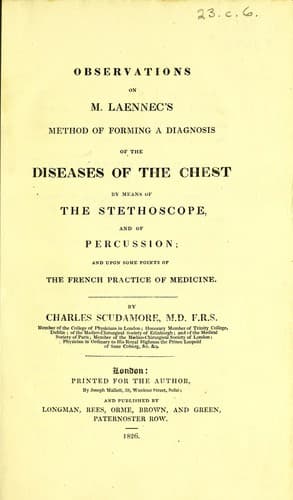
Observations on M. Laennec's method of forming a diagnosis of the diseases of the chest by means of the stethoscope, and of percussion; and upon some points of the French practice of medicineScudamore, Charles
Science
Observations on M. Laennec's method of forming a diagnosis of the diseases of the chest by means of the stethoscope, and of percussion; and upon some points of the French practice of medicine
Scudamore, Charles
Chest -- Diseases -- Diagnosis; Laennec, R. T. H. (René Théophile Hyacinthe), 1781-1826
I do not consider it to be proved, that the sulphate of quinine
embraces all the useful qualities of the entire bark; although, from
its power in curing intermittent fever, we may conclude that it
possesses the most important. Two of the principles which are removed
by the process for obtaining the sulphate, namely, the quinic acid,
and resin, must not be disregarded.
I have sometimes found the decoction of bark more acceptable to
the stomach, and more useful, than the sulphate of quinine, and
particularly grateful when given with the carbonate of potash and
lemon juice in effervescence, adding also some tincture and syrup of
orange peel.
Bark in substance very often oppresses the stomach, and seems to
impair both the appetite and digestion, which in general become
improved by the influence of the sulphate of quinine. Indeed,
formerly, when in the habit of directing large and frequent doses
of the powder of bark for the cure of ague, I found it expedient
almost to forbid food, seeing that the stomach was sufficiently
occupied with the presence of the bark. It is scarcely necessary to
observe, that, in some cases of ague, where the digestive organs, and
the liver especially, are in fault, bark, in any form, is not the
appropriate medicine for the cure.
The sulphate of quinine is unquestionably a powerful and excellent
tonic, and at the same time does not stimulate unfavourably. I
am accustomed to prescribe it with great success to patients
convalescent from gout; to whom on all former occasions, bark in its
other forms had proved unsuitable, tending to re-excite the gouty
action.
The acetate of morphine is another of the new medicines derived from
the French chemists, which we can administer advantageously to those
individuals who are too much stimulated by the ordinary preparations
of opium. The process[9] employed for the separation of morphine from
opium, removes the resin, the narcotine, and meconic acid.
The black or Lancastrian drop owes its useful quality to the
circumstance of its containing a larger proportion of acetate of
morphine than the other principles of opium; but it is not so pure a
preparation as the acetate of morphine, prepared as I have described.
It appears to me that half a grain of the acetate of morphine is
about equal to a grain of the extract of opium.
When immediate relief from severe pain is sought to be obtained,
and that opium does not materially disagree with the patient, a
preference is due to the tincture of opium, as being a more powerful
anodyne than any of the other preparations which I have mentioned. I
have found, by experiment, that the resin, separated from the other
parts of opium, has an anodyne power, not inconsiderable.
Public-domain text, read in full here on John Shaqi.
Reviews
Reviews
No reviews yet
Be the first to share your thoughts on this work.
Join the Discussion
Join the discussion
Sign in to leave a comment or review.
Sign InorCreate an account