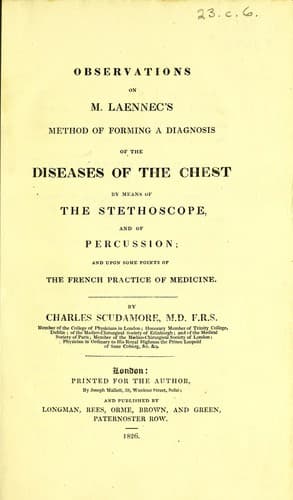
Observations on M. Laennec's method of forming a diagnosis of the diseases of the chest by means of the stethoscope, and of percussion; and upon some points of the French practice of medicineScudamore, Charles
Science
Observations on M. Laennec's method of forming a diagnosis of the diseases of the chest by means of the stethoscope, and of percussion; and upon some points of the French practice of medicine
Scudamore, Charles
Chest -- Diseases -- Diagnosis; Laennec, R. T. H. (René Théophile Hyacinthe), 1781-1826
The hydrocyanic (prussic) acid is a valuable medicine, but requires,
according to my observation, more care in the administration of
full doses, than any other medicine. It may be given in small doses,
usually, without any inconvenience. When its qualities were first
proclaimed, it was too highly extolled as a remedy in phthisis
pulmonalis; and, from consequent disappointment, I conceive that its
just merits are not sufficiently appreciated. In some cases of hectic
fever, attended with urgent cough, I have procured the happiest
effects from the use of this medicine. I have not, with the adult
patient, in any instance, prescribed more than twenty-four minims as
the total quantity, in twenty-four hours; and usually have confined
myself to the extent of fifteen, always commencing with small doses.
In order that this medicine may be given with reliance on its
properties, it is necessary that it should be kept in the dark, in
a cool situation, and that the vial should be accurately stopped.
I proceed to offer a cursory account of several of the other new
medicines.
The alcoholic extract of nux vomica exerts a special and powerful
influence on the spinal marrow, and has produced very beneficial
effects in some urgent cases of paralysis. It may be given either
in general or local palsy, provided that inflammatory action be not
present; that there be no indications threatening apoplexy; and that
due care be taken in its administration.
In order to obtain the beneficial effects of the medicine in very
confirmed cases of paralysis, we are informed by M. Magendie, that
the paralytic limbs should experience some convulsive action; and
this, he says, usually takes place in the course of a few days. Then
the dose of the medicine is to be lessened. It is administered with
most advantage in the form of a pill. A quarter of a grain is the
least dose which need be used in the beginning for an adult; and it
may be given twice or thrice in the day. The dose is to be increased
according to its effects: and it is stated by M. Magendie, that some
persons have borne the augmented quantity of thirty grains in the
day: but from four to six grains per diem, is the maximum amount
usually required. This distinguished physiologist mentions that, in
Italy, the following tincture is very much employed for the treatment
of paralytic limbs, by means of friction:
Alcohol, one ounce,
Dry extract of nux vomica, three grains.
Dr. Edwards, at Paris, was successful with nux vomica in a case
of amaurosis, or gutta serena, accompanied with a paralysis of
the upper eye-lid. It has afforded great benefit in many cases of
local paralysis, affecting different parts of the body in different
examples.
A medical friend informs me, that he obtained very great advantage
from this medicine in the treatment of a severe case of tic
douloureux, after various other medicines had failed to give relief.
Public-domain text, read in full here on John Shaqi.
Reviews
Reviews
No reviews yet
Be the first to share your thoughts on this work.
Join the Discussion
Join the discussion
Sign in to leave a comment or review.
Sign InorCreate an account