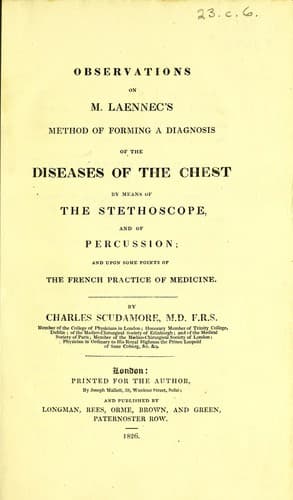
Observations on M. Laennec's method of forming a diagnosis of the diseases of the chest by means of the stethoscope, and of percussion; and upon some points of the French practice of medicineScudamore, Charles
Science
Observations on M. Laennec's method of forming a diagnosis of the diseases of the chest by means of the stethoscope, and of percussion; and upon some points of the French practice of medicine
Scudamore, Charles
Chest -- Diseases -- Diagnosis; Laennec, R. T. H. (René Théophile Hyacinthe), 1781-1826
The other case was that of a young woman, affected with many of the
same symptoms which I have related in the foregoing case, but in a
more acute degree. From accidental circumstances timely treatment had
been omitted; and I found the highest degree of general fever, with
a pulse frequent, hard, and obstructed. The breathing was laborious,
but not attended with any fixed pain in the chest. Her voice was
rather hoarse, and had lost its natural tones. The cough was urgent,
and the expectoration took place with difficulty. The expectorated
matter was, for the most part, frothy, and had a remarkably acid
odour. The cheeks were flushed with a deep hue of purplish red, and
the lips assumed a very dark appearance. Such was the laboured state
of the circulation, that the patient was affected with an almost
constant disposition to faint. She complained of a sense of extreme
burning, and also of soreness, over the whole of the chest. She had
not enjoyed any sleep for three nights, nor any in the day; her mind
was occasionally delirious; and her countenance wore the greatest
anxiety.
In the upper part of the right side of the chest, I discovered by
the stethoscope remarkably acute sounds, both in inspiration and
expiration, and in the left side similar sounds, but in a weaker
degree. I also distinguished the mucous rattle in some points. Blood
was taken freely from the arm, and it was cupped and buffy in the
extreme. Sixteen leeches of full size were applied to the right
side, and eight to the left side of the chest. Tartar emetic was
administered internally in the manner I have before mentioned. The
altered and improved situation of the patient in a few hours, was
equally remarkable and satisfactory. All the urgent symptoms were
alleviated, but all continued sufficiently troublesome to require a
repetition of general and local bleeding, in the course of the three
following days. It is worthy of remark, that free depletion removed
the disposition to faint. At the end of eight days, the symptoms
of active inflammation were removed, and at the same period the
sounds had ceased, and the stethoscope afforded only the indication
of the mucous rattle. The tartar emetic solution, although joined
with the syrup of poppy, caused more than usual sickness in this
case; but it appeared highly beneficial, by useful instruction in
regard to the seat, the removing more freely, than the simple act of
expectoration could accomplish, the viscid matter, which, latterly,
was muco-puriform, and was less acid in odour. After the reduction of
the inflammation, pulv. ipecac. compos. was given in a saline draught
at night, with great advantage in assisting sleep and allaying cough.
This patient is convalescent and takes the mild medicine of
sarsaparilla with hot milk, just now described, in conjunction with
the draught at night, and gentle aperients occasionally.
Public-domain text, read in full here on John Shaqi.
Reviews
Reviews
No reviews yet
Be the first to share your thoughts on this work.
Join the Discussion
Join the discussion
Sign in to leave a comment or review.
Sign InorCreate an account